中文English
ISSN 1001-5256 (Print)
ISSN 2097-3497 (Online)
CN 22-1108/R
Volume 41 Issue 10
Oct.  2025
Turn off MathJax
Article Contents

Expression profiles of HBsAg and HBcAg in liver tissue and their correlation with serological markers in children with chronic hepatitis B

DOI: 10.12449/JCH251013
Research funding:

National Key R&D Program of China (2023YFC2308104);

Beijing Hospitals Authority Clinical Medicine Development of Special Funding Support (ZLRK202301)

More Information
  • Corresponding author: ZHAO Jingmin, jmzhao302@163.com (ORCID: 0000-0003-4345-2149)
  • Received Date: 2025-04-14
  • Accepted Date: 2025-05-15
  • Published Date: 2025-10-25
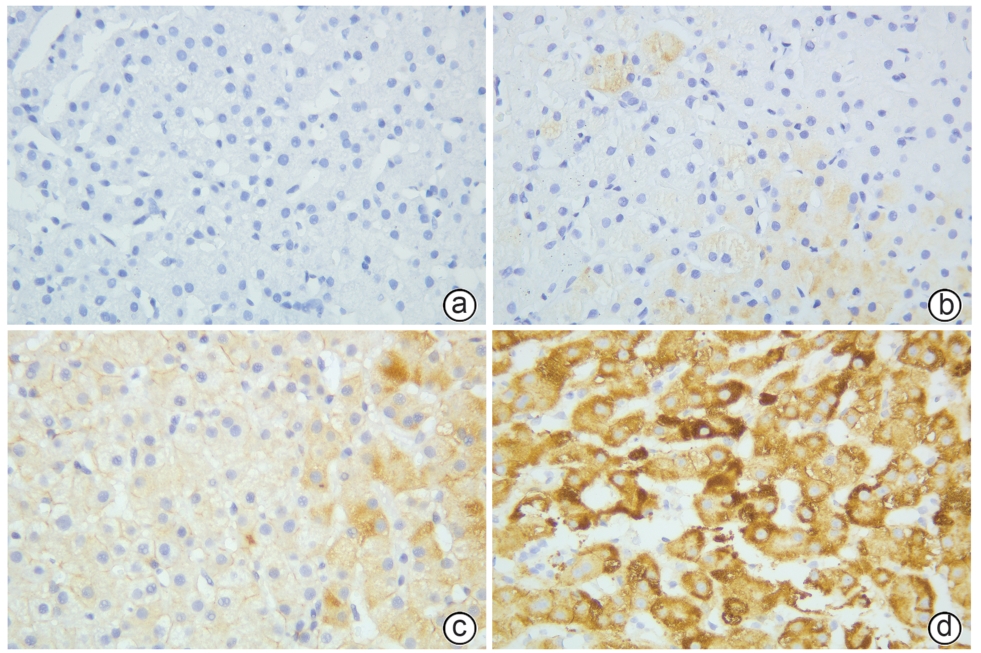
  •   Objective  To investigate the expression features of HBsAg and HBcAg in liver tissue and their correlation with HBV serum markers in children with chronic hepatitis B (CHB).  Methods  A total of 257 patients who were consecutively admitted to The Fifth Medical Center of Chinese PLA General Hospital from January 2013 to December 2023 and underwent liver biopsy to achieve a confirmed diagnosis of CHB were enrolled in this study. The NIS-Elements system was used to capture the immunohistochemical images of HBsAg and HBcAg in liver tissues, and Image J software was used for quantitative analysis. The one-sample chi-square test was used for within-group comparison of continuous data, and the Pearson/Spearman/Kendall’s Tau-b correlation analysis was used to investigate the correlation between viral antigen expression and serological markers.  Results  Among the 257 CHB patients, there were 162 children (76 children aged<5 years and 86 children aged 5 — 18 years) and 95 adults. There were significant differences in the expression pattern, area, and intensity of HBsAg and the area and intensity of HBcAg in liver tissue between different age groups and between the children with different HBeAg statuses (all P<0.05). In the children aged<5 years, HBsAg staining area was significantly negatively correlated with anti-HBs and HBeAg (both P<0.05)and was significantly positively correlated with ALT and AST (both P<0.05), and HBsAg staining intensity was significantly positively correlated with qHBsAg (P<0.05) and was significantly negatively correlated with anti-HBs (P<0.05). In the children group, HBsAg staining area was negatively correlated with anti-HBs and HBeAg (both P<0.05), and HBsAg staining intensity was positively correlated with qHBsAg (P<0.05) and was negatively correlated with anti-HBs (P<0.05). In the adult group, HBsAg staining area was positively correlated with ALT, AST, and liver inflammatory activity (all P<0.05), and HBsAg staining intensity was positively correlated with qHBsAg, HBeAg, and HBV DNA (all P<0.05) and was negatively correlated with liver inflammatory activity and fibrosis degree (both P<0.05). In the children aged<5 years, HBcAg staining area was positively correlated with qHBsAg and HBV DNA (both P<0.05), and HBcAg staining intensity was significantly positively correlated with HBV DNA (P<0.001). In the children aged 5 — 18 years, the area and intensity of HBcAg staining were positively correlated with qHBsAg, HBeAg, and HBV DNA (all P<0.05). In the children group, HBcAg staining area was positively correlated with qHBsAg, HBeAg, and HBV DNA (all P<0.05), and HBcAg staining intensity was positively correlated with qHBsAg and HBV DNA (both P<0.05). In the adult group, the area and intensity of HBcAg staining were positively correlated with qHBsAg, HBeAg, and HBV DNA (all P<0.001), and HBcAg staining area was positively correlated with the serum level of ALT (P=0.043).  Conclusion  The expression levels of HBsAg and HBcAg in liver tissue of children with CHB are significantly correlated with serological markers, and in clinical practice, HBsAg and HBcAg combined with serological markers can help to assess the condition of the liver, determine the immune stage, and provide evidence-based guidance for treatment timing.


  • loading
  • [1]
    BURKI T. WHO’s 2024 global hepatitis report[J]. Lancet Infect Dis, 2024, 24( 6): e362- e363. DOI: 10.1016/S1473-3099(24)00307-4.
    [2]
    INDOLFI G, EASTERBROOK P, DUSHEIKO G, et al. Hepatitis B virus infection in children and adolescents[J]. Lancet Gastroenterol Hepatol, 2019, 4( 6): 466- 476. DOI: 10.1016/S2468-1253(19)30042-1.
    [3]
    JENG WJ, PAPATHEODORIDIS GV, LOK ASF. Hepatitis B[J]. Lancet, 2023, 401( 10381): 1039- 1052. DOI: 10.1016/S0140-6736(22)01468-4.
    [4]
    Chinese Society of Infectious Diseases, Chinese Medical Association; Chinese Society of Hepatology, Chinese Medical Association; Group of Infectious Diseases, Chinese Pediatric Society, Chinese Medical Association, et al. Expert consensus on the prevention and treatment of chronic hepatitis B in children[J]. Infect Dis Info, 2024, 37( 2): 97- 112. DOI: 10.3969/j.issn.1007-8134.2024.02.001.

    中华医学会感染病学分会, 中华医学会肝病学分会, 中华医学会儿科学分会感染学组, 等. 儿童慢性乙型肝炎防治专家共识[J]. 传染病信息, 2024, 37( 2): 97- 112. DOI: 10.3969/j.issn.1007-8134.2024.02.001.
    [5]
    SAFAIE P, POONGKUNRAN M, KUANG PP, et al. Intrahepatic distribution of hepatitis B virus antigens in patients with and without hepatocellular carcinoma[J]. World J Gastroenterol, 2016, 22( 12): 3404- 3411. DOI: 10.3748/wjg.v22.i12.3404.
    [6]
    ALPSOY A, ADANIR H, BAYRAMOGLU Z, et al. Correlation of hepatitis B surface antigen expression with clinicopathological and biochemical parameters in liver biopsies: A comprehensive study[J]. World J Hepatol, 2022, 14( 1): 260- 273. DOI: 10.4254/wjh.v14.i1.260.
    [7]
    ZHANG XM, MA XQ, XU ZJ, et al. Effect of drug-resistant mutations in reverse transcriptase region of hepatitis B virus on the level of serum hepatitis B surface antigen[J/CD]. Chin J Exp Clin Infect Dis(Electronic Edition), 2023, 17( 5): 324- 332. DOI: 10.3877/cma.j.issn.1674-1358.2023.05.006.

    张小曼, 马筱秋, 许正锯, 等. 乙型肝炎病毒逆转录酶区耐药突变对血清乙型肝炎病毒表面抗原水平的影响[J/CD]. 中华实验和临床感染病杂志(电子版), 2023, 17( 5): 324- 332. DOI: 10.3877/cma.j.issn.1674-1358.2023.05.006.
    [8]
    Chinese Society of Hepatology and Chinese Society of Infectious Diseases, Chinese Medical Association. The guideline of prevention and treatment for chronic hepatitis B(2010 version)[J]. J Clin Hepatol, 2011, 27( 1): 113- 128.

    中华医学会肝病学分会, 中华医学会感染病学分会. 慢性乙型肝炎防治指南(2010年版)[J]. 临床肝胆病杂志, 2011, 27( 1): 113- 128.
    [9]
    National Health Commission. Reference intervals of clinical biochemistry tests commonly used for children: WS/T 780-2021[S/OL].( 2021-04-09). http://www.nhc.gov.cn/wjw/s9492/202105/170ca00246014d18b82a61cabf9fdb2f.shtml. http://www.nhc.gov.cn/wjw/s9492/202105/170ca00246014d18b82a61cabf9fdb2f.shtml

    国家卫生健康委员会. 儿童临床常用生化检验项目参考区间: WS/T 780-2021[S/OL].( 2021-04-09). http://www.nhc.gov.cn/wjw/s9492/202105/170ca00246014d18b82a61cabf9fdb2f.shtml. http://www.nhc.gov.cn/wjw/s9492/202105/170ca00246014d18b82a61cabf9fdb2f.shtml
    [10]
    SCHEUER PJ. Classification of chronic viral hepatitis: A need for reassessment[J]. J Hepatol, 1991, 13( 3): 372- 374. DOI: 10.1016/0168-8278(91)90084-o.
    [11]
    Chinese Society of Hepatology, Chinese Medical Association; Chinese Society of Infectious Diseases, Chinese Medical Association. Guidelines for the prevention and treatment of chronic hepatitis B(version 2022)[J]. Infect Dis Info, 2023, 36( 1): 1- 17. DOI: 10.3969/j.issn.1007-8134.2023.01.01.

    中华医学会肝病学分会, 中华医学会感染病学分会. 慢性乙型肝炎防治指南(2022年版)[J]. 传染病信息, 2023, 36( 1): 1- 17. DOI: 10.3969/j.issn.1007-8134.2023.01.01.
    [12]
    SU TH, LIU CJ, YANG HC, et al. Clinical significance and evolution of hepatic HBsAg expression in HBeAg-positive patients receiving interferon therapy[J]. J Gastroenterol, 2014, 49( 2): 356- 362. DOI: 10.1007/s00535-013-0840-z.
    [13]
    LIU L, LIU CY, LI JY, et al. Analysis of pathological changes of liver tissue in patients with low level HBsAg[J]. Chongqing Med, 2018, 47( 8): 1109- 1111. DOI: 10.3969/j.issn.1671-8348.2018.08.032.

    刘立, 刘春云, 李俊义, 等. 低水平HBsAg患者肝脏组织病理变化分析[J]. 重庆医学, 2018, 47( 8): 1109- 1111. DOI: 10.3969/j.issn.1671-8348.2018.08.032.
    [14]
    RAMAKRISHNA B, MUKHOPADHYA A, KURIAN G. Correlation of hepatocyte expression of hepatitis B viral antigens with histological activity and viral titer in chronic hepatitis B virus infection: An immunohistochemical study[J]. J Gastroenterol Hepatol, 2008, 23( 11): 1734- 1738. DOI: 10.1111/j.1440-1746.2008.05416.x.
    [15]
    SERINOZ E, VARLI M, ERDEN E, et al. Nuclear localization of hepatitis B core antigen and its relations to liver injury, hepatocyte proliferation, and viral load[J]. J Clin Gastroenterol, 2003, 36( 3): 269- 272. DOI: 10.1097/00004836-200303000-00016.
    [16]
    UZUN Y, BOZKAYA H, ERDEN E, et al. Hepatitis B core antigen expression pattern reflects the response to anti-viral treatment[J]. J Gastroenterol Hepatol, 2006, 21( 6): 977- 981. DOI: 10.1111/j.1440-1746.2006.04263.x.
    [17]
    GIADANS CG, RÍOS DA, AMEIGEIRAS B, et al. Chronic hepatitis B: The interplay between intrahepatic lymphocyte population and viral antigens in relation to liver damage[J]. J Viral Hepat, 2019, 26( 6): 727- 737. DOI: 10.1111/jvh.13078.
  • 加载中

Catalog

    通讯作者: 陈斌, bchen63@163.com
    • 1. 

      沈阳化工大学材料科学与工程学院 沈阳 110142

    1. 本站搜索
    2. 百度学术搜索
    3. 万方数据库搜索
    4. CNKI搜索

    Figures(1)  / Tables(9)

    Article Metrics

    Article views (62) PDF downloads(13) Cited by()
    Proportional views
    Related

    /

    DownLoad:  Full-Size Img  PowerPoint
    Return
    Return