中文English
ISSN 1001-5256 (Print)
ISSN 2097-3497 (Online)
CN 22-1108/R
Volume 41 Issue 4
Apr.  2025
Turn off MathJax
Article Contents

Accuracy of multivariate discriminant analysis versus fibrosis-4 in evaluating the liver fibrosis degree in patients with chronic HBV infection

DOI: 10.12449/JCH250412
Research funding:

National Natural Science Foundation of China (82160123)

More Information
  • Corresponding author: SU Minghua, smh9292@163.com (ORCID: 0000-0001-7831-6580)
  • Received Date: 2024-09-18
  • Accepted Date: 2024-10-19
  • Published Date: 2025-04-25
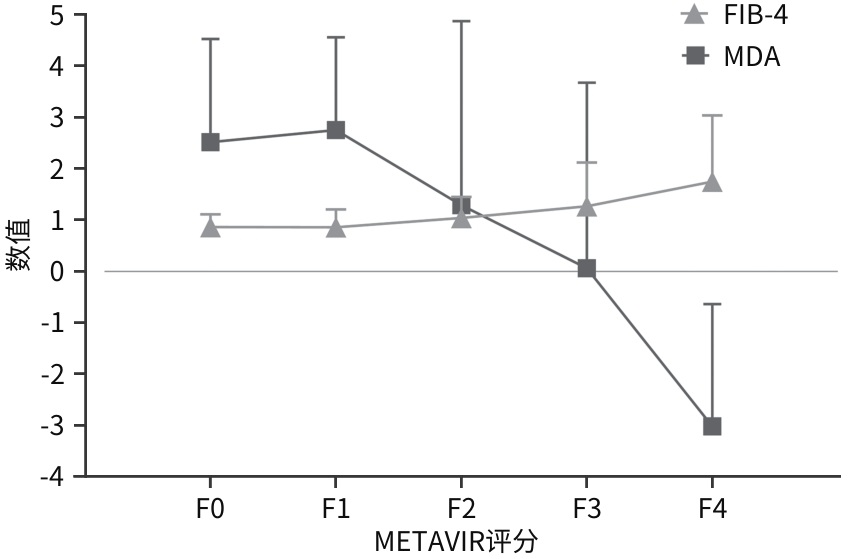
  •   Objective  To investigate the accuracy of multiple discriminant analysis (MDA) versus fibrosis-4 (FIB-4) in assessing liver fibrosis degree in patients with HBV infection, as well as the possibility of MDA as an indicator for disease progression.  Methods  A total of 263 patients with HBV infection who underwent liver biopsy in The First Affiliated Hospital of Guangxi Medical University from April 2010 to April 2024 were included, and their clinical data were collected. According to the results of pathological examination, they were divided into non-significant fibrosis group (F<2) with 126 patients and significant fibrosis group (F≥2) with 137 patients. The correlation of MDA and FIB-4 with liver fibrosis degree was analyzed, and MDA and FIB-4 were compared in terms of their accuracy in assessing significant liver fibrosis. A total of 62 patients completed follow-up, and according to the presence or absence of progression to liver cirrhosis at the last follow-up visit, they were divided into progressive group with 21 patients and non-progressive group with 41 patients; the efficacy of MDA and FIB-4 in diagnosing disease progression was analyzed and compared. The independent-samples t test was used for comparison of normally distributed continuous data between groups, and the Mann-Whitney U test was used for comparison of non-normally distributed continuous data between groups; the Kruskal-Wallis H test was used for comparison between multiple groups, and the Bonferroni method was used for further comparison between two groups. The chi-square test was used for comparison of categorical data. The Spearman’s correlation coefficient was used for correlation analysis. The Wilcoxon signed rank sum test was used for the analysis of baseline data and data at the end of follow-up, and the binary Logistic regression analysis was used to investigate the influencing factors for progression to liver cirrhosis. The receiver operating characteristic (ROC) curve was used to investigate the diagnostic efficacy of indicators, the Z-test was used for comparison of the area under the ROC curve (AUC), and the paired chi-square test was used for comparison of the sensitivity, specificity, and accuracy of the two indicators.  Results  The correlation coefficient between FIB-4 and liver fibrosis degree was 0.378, while the correlation coefficient between MDA and liver fibrosis degree was -0.325 (both P<0.001). FIB-4 had an AUC of 0.688, a sensitivity of 64.96%, a specificity of 68.87%, a positive predictive value of 67.42%, a negative predictive value of 63.36%, an accuracy of 65.40%, and a cut-off value of 1.01, while MDA had an AUC of 0.653, a sensitivity of 52.55%, a specificity of 78.57%, a positive predictive value of 72.73%, a negative predictive value of 60.37%, an accuracy of 65.02%, and a cut-off value of 0.29, suggesting that compared with FIB-4, MDA had a lower sensitivity (P=0.004) and a higher specificity (P=0.001). The progressive group had a significantly higher age than the non-progressive group at baseline (t=2.611, P=0.011). For the progressive group, there was an increase in FIB-4 and a reduction in MDA from baseline to the end of follow-up (both P<0.001), while the non-progressive group showed no significant changes (both P>0.05). The multivariate Logistic regression analysis showed that aspartate aminotransferase (odds ratio [OR]=0.940, 95% confidence interval [CI]: 0.885‍ ‍—‍ ‍0.998, P<0.05) and MDA (OR=0.445, 95%CI: 0.279‍ ‍—‍ ‍0.710, P<0.001) were independent influencing factors for disease progression. MDA had an AUC of 0.893 and an optimal cut-off value of -0.01 in diagnosing the disease progression of liver cirrhosis.  Conclusion  MDA has a comparable accuracy to FIB-4 in the diagnosis of significant liver fibrosis, and MDA<-0.01 has a high accuracy in diagnosing the progression of liver fibrosis to liver cirrhosis, which can help to reduce the need for liver biopsy in clinical practice.


  • loading
  • [1]
    Chinese Society of Hepatology, Chinese Medical Association; Chinese Society of Gastroenterology, Chinese Medical Association; Chinese Society of Infectious Diseases, Chinese Medical Association. Consensus on the diagnosis and therapy of hepatic fibrosis(2019)[J]. J Clin Hepatol, 2019, 35( 10): 2163- 2172. DOI: 10.3969/j.issn.1001-5256.2019.10.007.

    中华医学会肝病学分会, 中华医学会消化病学分会, 中华医学会感染病学分会. 肝纤维化诊断及治疗共识(2019年)[J]. 临床肝胆病杂志, 2019, 35( 10): 2163- 2172. DOI: 10.3969/j.issn.1001-5256.2019.10.007.
    [2]
    LIAO ZH, XIE ZY. Research progress in molecular mechanism of hepatic fibrosis and related therapeutic targets[J]. J Jilin Univ(Med Edit), 2024, 50( 5): 1450- 1456. DOI: 10.13481/j.1671-587X.20240532.

    廖昭辉, 谢正元. 肝纤维化发病的分子机制及其相关治疗靶点的研究进展[J]. 吉林大学学报(医学版), 2024, 50( 5): 1450- 1456. DOI: 10.13481/j.1671-587X.20240532.
    [3]
    SAPMAZ FP, BÜYÜKTURAN G, SAKIN YS, et al. How effective are APRI, FIB-4, FIB-5 scores in predicting liver fibrosis in chronic hepatitis B patients?[J]. Medicine(Baltimore), 2022, 101( 36): e30488. DOI: 10.1097/MD.0000000000030488.
    [4]
    BELLAN M, CASTELLO LM, PIRISI M. Candidate biomarkers of liver fibrosis: A concise, pathophysiology-oriented review[J]. J Clin Transl Hepatol, 2018, 6( 3): 317- 325. DOI: 10.14218/JCTH.2018.00006.
    [5]
    DONG XQ, WU Z, ZHAO H, et al. Evaluation and comparison of thirty noninvasive models for diagnosing liver fibrosis in Chinese hepatitis B patients[J]. J Viral Hepat, 2019, 26( 2): 297- 307. DOI: 10.1111/jvh.13031.
    [6]
    ATTALLAH AM, SHIHA GE, OMRAN MM, et al. A discriminant score based on four routine laboratory blood tests for accurate diagnosis of severe fibrosis and/or liver cirrhosis in Egyptian patients with chronic hepatitis C[J]. Hepatol Res, 2006, 34( 3): 163- 169. DOI: 10.1016/j.hepres.2005.12.004.
    [7]
    Chinese Society of Hepatology, Chinese Medical Association; Chinese Society of Infectious Diseases, Chinese Medical Association. Guidelines for the prevention and treatment of chronic hepatitis B(version 2022)[J]. Infect Dis Info, 2023, 36( 1): 1- 17. DOI: 10.3969/j.issn.1007-8134.2023.01.01.

    中华医学会肝病学分会, 中华医学会感染病学分会. 慢性乙型肝炎防治指南(2022年版)[J]. 传染病信息, 2023, 36( 1): 1- 17. DOI: 10.3969/j.issn.1007-8134.2023.01.01.
    [8]
    MALLET V, DHALLUIN-VENIER V, ROUSSIN C, et al. The accuracy of the FIB-4 index for the diagnosis of mild fibrosis in chronic hepatitis B[J]. Aliment Pharmacol Ther, 2009, 29( 4): 409- 415. DOI: 10.1111/j.1365-2036.2008.03895.x.
    [9]
    WANG H, XUE L, YAN R, et al. Comparison of FIB-4 and APRI in Chinese HBV-infected patients with persistently normal ALT and mildly elevated ALT[J]. J Viral Hepat, 2013, 20( 4): e3-10. DOI: 10.1111/jvh.12010.
    [10]
    BEDOSSA P, POYNARD T. An algorithm for the grading of activity in chronic hepatitis C. The METAVIR Cooperative Study Group[J]. Hepatology, 1996, 24( 2): 289- 293. DOI: 10.1002/hep.510240201.
    [11]
    Chinese Society of Hepatology, Chinese Medical Association. Chinese guidelines on the management of liver cirrhosis[J]. J Clin Hepatol, 2019, 35( 11): 2408- 2425. DOI: 10.3969/j.issn.1001-5256.2019.11.006.

    中华医学会肝病学分会. 肝硬化诊治指南[J]. 临床肝胆病杂志, 2019, 35( 11): 2408- 2425. DOI: 10.3969/j.issn.1001-5256.2019.11.006.
    [12]
    SRINIVASA BABU A, WELLS ML, TEYTELBOYM OM, et al. Elastography in chronic liver disease: Modalities, techniques, limitations, and future directions[J]. Radiographics, 2016, 36( 7): 1987- 2006. DOI: 10.1148/rg.2016160042.
    [13]
    ZHU L, YANG JR, HE LL, et al. Advances on the application of transient elastography in the diagnosis of liver fibrosis[J/CD]. Chin J Liver Dis(Electronic Version), 2023, 15( 3): 16- 22. DOI: 10.3969/j.issn.1674-7380.2023.03.003.

    朱璐, 杨君茹, 何玲玲, 等. 瞬时弹性成像在肝纤维化诊断中的应用研究进展[J/CD]. 中国肝脏病杂志(电子版), 2023, 15( 3): 16- 22. DOI: 10.3969/j.issn.1674-7380.2023.03.003.
    [14]
    ZHANG Q, MA Z. Progress on influencing factors and biomarkers for hepatic fibrosis progression of hepatitis C[J/CD]. Chin J Exp Clin Infect Dis(Electronic Edition), 2024, 18( 1): 1- 6. DOI: 10.3877/cma.j.issn.1674-1358.2024.01.001.

    张麒, 马臻. 丙型肝炎肝纤维化进展影响因素及标志物研究进展[J/CD]. 中华实验和临床感染病杂志(电子版), 2024, 18( 1): 1- 6. DOI: 10.3877/cma.j.issn.1674-1358.2024.01.001.
    [15]
    WANG Y, WANG M, ZHANG GH, et al. Clinical diagnosis, staging, and therapeutic principles of liver cirrhosis[J]. J Clin Hepatol, 2021, 37( 1): 17- 21. DOI: 10.3969/j.issn.1001-5256.2021.01.004.

    王宇, 王民, 张冠华, 等. 肝硬化的诊断、分期及治疗原则[J]. 临床肝胆病杂志, 2021, 37( 1): 17- 21. DOI: 10.3969/j.issn.1001-5256.2021.01.004.
    [16]
    CHEN W, HONG RT, LIU XC, et al. Value of fibrosis-4, aspartate aminotransferase-to-platelet ratio index, and globulin-platelet index in the diagnosis of significant liver fibrosis in autoimmune hepatitis[J]. J Clin Hepatol, 2020, 36( 9): 1955- 1959. DOI: 10.3969/j.issn.1001-5256.2020.09.009.

    陈薇, 洪汝涛, 刘晓昌, 等. FIB-4、APRI和GPI模型对自身免疫性肝炎显著肝纤维化的诊断价值[J]. 临床肝胆病杂志, 2020, 36( 9): 1955- 1959. DOI: 10.3969/j.issn.1001-5256.2020.09.009.
    [17]
    KIM WR, BERG T, ASSELAH T, et al. Evaluation of APRI and FIB-4 scoring systems for non-invasive assessment of hepatic fibrosis in chronic hepatitis B patients[J]. J Hepatol, 2016, 64( 4): 773- 780. DOI: 10.1016/j.jhep.2015.11.012.
    [18]
    JIANG YM, LIU J, YOU NN, et al. Evaluation of serum non-invasive methods for the diagnosis of liver fibrosis in patients with chronic hepatitis B virus infection[J]. Int J Epidemiol Infect Dis, 2022, 49( 4): 238- 241. DOI: 10.3760/cma.j.cn331340-20211209-00240.

    蒋艳明, 刘静, 尤宁宁, 等. 血清无创方法诊断慢性乙型肝炎病毒感染者肝纤维化的效果评价[J]. 国际流行病学传染病学杂志, 2022, 49( 4): 238- 241. DOI: 10.3760/cma.j.cn331340-20211209-00240.
    [19]
    DONG JJ, WANG YY, LIU K, et al. Diagnostic value of γ-glutamyl transpeptidase-to-platelet ratio index for hepatic fibrosis in patients with chronic hepatitis B[J]. Chin J Infect Dis, 2017, 35( 11): 670- 674. DOI: 10.3760/cma.j.issn.1000-6680.2017.11.006.

    董菁菁, 王允野, 刘昆, 等. γ-谷氨酰转肽酶和血小板比值指数对慢性乙型肝炎肝纤维化的诊断价值[J]. 中华传染病杂志, 2017, 35( 11): 670- 674. DOI: 10.3760/cma.j.issn.1000-6680.2017.11.006.
    [20]
    HUANG CM, YANG Z, NIE YQ, et al. Value of gamma-glutamyl transpeptidase-to-platelet ratio in predicting liver fibrosis stage in chronic hepatitis B patients in Guangdong, China[J]. J Clin Hepatol, 2018, 34( 6): 1204- 1208. DOI: 10.3969/j.issn.1001-5256.2018.06.015.

    黄春明, 杨湛, 聂玉强, 等. GGT/PLT比值对广东地区慢性乙型肝炎患者肝纤维化分期的预测价值[J]. 临床肝胆病杂志, 2018, 34( 6): 1204- 1208. DOI: 10.3969/j.issn.1001-5256.2018.06.015.
    [21]
    DONG BT, LYU GR, CHEN YP, et al. Comparison of two-dimensional shear wave elastography, magnetic resonance elastography, and three serum markers for diagnosing fibrosis in patients with chronic hepatitis B: A meta-analysis[J]. Expert Rev Gastroenterol Hepatol, 2021, 15( 9): 1077- 1089. DOI: 10.1080/17474124.2021.1880894.
    [22]
    XIAO GQ, YANG JY, YAN LN. Comparison of diagnostic accuracy of aspartate aminotransferase to platelet ratio index and fibrosis-4 index for detecting liver fibrosis in adult patients with chronic hepatitis B virus infection: A systemic review and meta-analysis[J]. Hepatology, 2015, 61( 1): 292- 302. DOI: 10.1002/hep.27382.
    [23]
    GORDON SC, LAMERATO LE, RUPP LB, et al. Antiviral therapy for chronic hepatitis B virus infection and development of hepatocellular carcinoma in a US population[J]. Clin Gastroenterol Hepatol, 2014, 12( 5): 885- 893. DOI: 10.1016/j.cgh.2013.09.062.
  • 加载中

Catalog

    通讯作者: 陈斌, bchen63@163.com
    • 1. 

      沈阳化工大学材料科学与工程学院 沈阳 110142

    1. 本站搜索
    2. 百度学术搜索
    3. 万方数据库搜索
    4. CNKI搜索

    Figures(1)  / Tables(6)

    Article Metrics

    Article views (609) PDF downloads(35) Cited by()
    Proportional views
    Related

    /

    DownLoad:  Full-Size Img  PowerPoint
    Return
    Return