中文English
ISSN 1001-5256 (Print)
ISSN 2097-3497 (Online)
CN 22-1108/R
Volume 41 Issue 4
Apr.  2025
Turn off MathJax
Article Contents

Prevalence, influencing factors, and fibrosis risk stratification of metabolic dysfunction-associated fatty liver disease in the health check-up population in Beijing, China

DOI: 10.12449/JCH250408
Research funding:

Beijing Municipal Administration of Hospitals Incubating Program (PX2023061);

Scientific Research Project of Beijing Youan Hospital (YNKTXF2021003)

More Information
  • Corresponding author: ZHANG Jing, zjyouan@ccmu.edu.cn (ORCID: 0000-0002-3082-8330)
  • Received Date: 2024-09-08
  • Accepted Date: 2024-10-11
  • Published Date: 2025-04-25
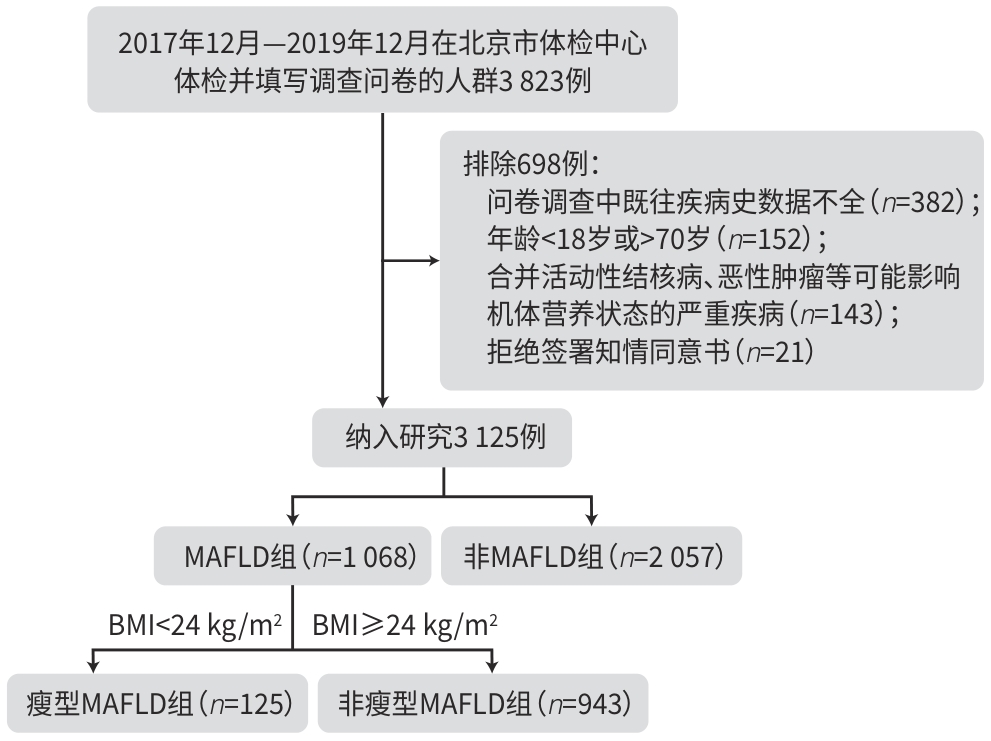
  •   Objective  To identify the patients with metabolic dysfunction-associated fatty liver disease (MAFLD) among the health check-up population, and to perform stratified management of patients with the low, medium, and high risk of advanced fibrosis based on noninvasive fibrosis scores.  Methods  A cross-sectional study was conducted among 3 125 individuals who underwent physical examination in Beijing Physical Examination Center from December 2017 to December 2019, and they were divided into MAFLD group with 1 068 individuals and non-MAFLD group with 2 057 individuals. According to BMI, the MAFLD group was further divided into lean MAFLD group (125 individuals with BMI<24 kg/m2) and non-lean MAFLD group (943 individuals with BMI≥24 kg/m2). Indicators including demographic data, past history, laboratory examination, and liver ultrasound were compared between groups. Fibrosis-4 (FIB-4) score, NAFLD fibrosis score (NFS), aspartate aminotransferase-to-platelet ratio index (APRI), and BARD score were calculated for the patients in the MAFLD group to assess the risk of advanced fibrosis. The independent-samples t test was used for comparison of normally distributed continuous data between two groups, and the Mann-Whitney U rank sum test was used for comparison of non-normally distributed continuous data between two groups; the chi-square test or the Fisher’s exact test was used for comparison of categorical data between groups. A logistic regression analysis was used to investigate the influence of each indicator in MAFLD.  Results  Compared with the non-MAFLD group, the MAFLD group had significantly higher age (Z=-9.758, P<0.05), proportion of male patients (χ2=137.555, P<0.05), and levels of body weight (Z=-27.987, P<0.05), BMI (Z=-32.714, P<0.05), waist circumference (Z=-31.805, P<0.05), hip circumference (Z=-26.342, P<0.05), waist-hip ratio (Z=-28.554, P<0.05), alanine aminotransferase (ALT) (Z=-25.820, P<0.05), aspartate aminotransferase (AST) (Z=-16.894, P<0.05), gamma-glutamyl transpeptidase (GGT) (Z=-25.069, P<0.05), alkaline phosphatase (Z=-12.533, P<0.05), triglyceride (Z=-27.559), total cholesterol (Z=-7.833, P<0.05), low-density lipoprotein cholesterol (LDL-C) (Z=-8.222, P<0.05), and uric acid (UA) (Z=-20.024, P<0.05), as well as a significantly higher proportion of patients with metabolic syndrome (MetS) (χ2=578.220, P<0.05), significantly higher prevalence rates of hypertension (χ2=241.694, P<0.05), type 2 diabetes (χ2=796.484, P<0.05), and dyslipidemia (χ2=369.843, P<0.05), and a significant reduction in high-density lipoprotein cholesterol (HDL-C) (Z=23.153, P<0.001). The multivariate logistic regression analysis showed that male sex (odds ratio [OR]=1.45, 95% confidence interval [CI]: 1.203‍ ‍—‍ ‍1.737), ALT (OR=1.05, 95%CI: 1.046‍ ‍—‍ ‍1.062), LDL-C (OR=1.23, 95%CI: 1.102‍ ‍—‍ ‍1.373), and comorbidity with MetS (OR=5.97, 95%CI: 4.876‍ ‍—‍ ‍7.316) were independently associated with MAFLD. Compared with the non-lean MAFLD group, the lean MAFLD group had significantly higher age (Z=3.736, P<0.05) and HDL-C (Z=2.679, P<0.05) and significant reductions in the proportion of male patients (χ2=28.970, P<0.05), body weight (Z=-14.230, P<0.05), BMI (Z=-18.188, P<0.05), waist circumference (Z=-13.451, P<0.05), hip circumference (Z=-13.317, P<0.05), ALT (Z=-4.519, P<0.05), AST (Z=-2.258, P<0.05), GGT (Z=-4.592, P<0.05), UA (Z=-4.415, P<0.05), the proportion of patients with moderate or severe fatty liver disease or MetS (χ2=42.564, P<0.05), and the prevalence rates of hypertension (χ2=12.057, P<0.05) and type 2 diabetes (χ2=3.174, P<0.05). Among the patients with MAFLD, 10 patients (0.9%) had an FIB-4 score of >2.67, 4 patients (0.4%) had an NFS score of >0.676, 8 patients (0.7%) had an APRI of >1, and 551 patients (51.6%) had a BARD score of ≥2.  Conclusion  There is a relatively high prevalence rate of MAFLD among the health check-up population in Beijing, but with a relatively low number of patients with a high risk of advanced fibrosis, and such patients need to be referred to specialized hospitals for liver diseases.


  • loading
  • [1]
    ZHOU JH, ZHOU F, WANG WX, et al. Epidemiological features of NAFLD from 1999 to 2018 in China[J]. Hepatology, 2020, 71( 5): 1851- 1864. DOI: 10.1002/hep.31150.
    [2]
    ZHAO Q, MENG XY, WANG Y, et al. Development and validation of a predicting nomogram for metabolic associated fatty liver disease in patients with type 2 diabetes mellitus[J/CD]. Chin J Liver Dis(Electronic Version), 2024, 16( 2): 48- 54. DOI: 10.3969/j.issn.1674-7380.2024.02.009.

    赵倩, 孟祥英, 王奕, 等. 2型糖尿病患者代谢相关脂肪性肝病列线图预测模型的建立与验证[J/CD]. 中国肝脏病杂志(电子版), 2024, 16( 2): 48- 54. DOI: 10.3969/j.issn.1674-7380.2024.02.009.
    [3]
    DUELL PB, WELTY FK, MILLER M, et al. Nonalcoholic fatty liver disease and cardiovascular risk: A scientific statement from the American heart association[J]. Arterioscler Thromb Vasc Biol, 2022, 42( 6): e168- e185. DOI: 10.1161/ATV.0000000000000153.
    [4]
    SUN DQ, TARGHER G, BYRNE CD, et al. An international Delphi consensus statement on metabolic dysfunction-associated fatty liver disease and risk of chronic kidney disease[J]. Hepatobiliary Surg Nutr, 2023, 12( 3): 386- 403. DOI: 10.21037/hbsn-22-421.
    [5]
    THOMAS JA, KENDALL BJ, DALAIS C, et al. Hepatocellular and extrahepatic cancers in non-alcoholic fatty liver disease: A systematic review and meta-analysis[J]. Eur J Cancer, 2022, 173: 250- 262. DOI: 10.1016/j.ejca.2022.06.051.
    [6]
    WANG YK, WEI SY, LIU C, et al. A new definition of fatty liver disease: from nonalcoholic fatty liver disease to metabolic asso-ciated fatty liver disease[J]. Chin J Dig Surg, 2023, 22( S1): 117- 121. DOI: 10.3760/cma.j.cn115610-20230909-00080.

    王永康, 魏诗雨, 刘昌, 等. 脂肪性肝病新定义: 从非酒精性脂肪性肝病到代谢功能障碍相关脂肪性肝病[J]. 中华消化外科杂志, 2023, 22( S1): 117- 121. DOI: 10.3760/cma.j.cn115610-20230909-00080.
    [7]
    Chinese Society of Hepatology, Chinese Medical Association. Guidelines for the prevention and treatment of metabolic dysfunction-associated(non-alcoholic) fatty liver disease(Version 2024)[J]. J Prac Hepatol, 2024, 27( 4): 494- 510. DOI: 10.3760/cma.j.cn501113-20240327-00163.

    中华医学会肝病学分会. 代谢相关(非酒精性)脂肪性肝病防治指南(2024年版)[J]. 实用肝脏病杂志, 2024, 27( 4): 494- 510. DOI: 10.3760/cma.j.cn501113-20240327-00163.
    [8]
    NAN YM, AN JH, BAO JF, et al. The Chinese Society of Hepatology position statement on the redefinition of fatty liver disease[J]. J Hepatol, 2021, 75( 2): 454- 461. DOI: 10.1016/j.jhep.2021.05.003.
    [9]
    DUSEJA A, SINGH SP, DE A, et al. Indian national association for study of the liver(INASL) guidance paper on nomenclature, diagnosis and treatment of nonalcoholic fatty liver disease(NAFLD)[J]. J Clin Exp Hepatol, 2023, 13( 2): 273- 302. DOI: 10.1016/j.jceh.2022.11.014.
    [10]
    RIGOR J, DIEGUES A, PRESA J, et al. Noninvasive fibrosis tools in NAFLD: Validation of APRI, BARD, FIB-4, NAFLD fibrosis score, and hepamet fibrosis score in a Portuguese population[J]. Postgrad Med, 2022, 134( 4): 435- 440. DOI: 10.1080/00325481.2022.2058285.
    [11]
    SANCHEZ-BAO AM, SOTO-GONZALEZ A, DELGADO-BLANCO M, et al. Identifying advanced MAFLD in a cohort of T2DM and clinical features[J]. Front Endocrinol(Lausanne), 2023, 14: 1058995. DOI: 10.3389/fendo.2023.1058995.
    [12]
    ARSLAN AY, CELIK S, AMIN F, et al. Prevalence, determinants, and fibrosis risk stratification of metabolic-associated fatty liver disease in a Turkish primary care setting: A retrospective study[J]. Hepatol Forum, 2023, 5( 2): 63- 67. DOI: 10.14744/hf.2023.2023.0027.
    [13]
    LIU ZY, ZHUANG YJ, DONG X, et al. Construction of non-invasive diagnostic model for liver fibrosis in nonalcoholic fatty liver disease[J]. Clin J Med Offic, 2024, 52( 7): 688- 691. DOI: 10.16680/j.1671-3826.2024.07.07.

    刘正一, 庄颖洁, 董旭, 等. 非酒精性脂肪性肝病肝纤维化无创诊断模型构建[J]. 临床军医杂志, 2024, 52( 7): 688- 691. DOI: 10.16680/j.1671-3826.2024.07.07.
    [14]
    MAN S, DENG YH, MA Y, et al. Prevalence of liver steatosis and fibrosis in the general population and various high-risk populations: A nationwide study with 5.7 million adults in China[J]. Gastroenterology, 2023, 165( 4): 1025- 1040. DOI: 10.1053/j.gastro.2023.05.053.
    [15]
    MUZUROVIĆ E, MIKHAILIDIS DP, MANTZOROS C. Non-alcoholic fatty liver disease, insulin resistance, metabolic syndrome and their association with vascular risk[J]. Metabolism, 2021, 119: 154770. DOI: 10.1016/j.metabol.2021.154770.
    [16]
    TANG A, NG CH, PHANG PH, et al. Comparative burden of metabolic dysfunction in lean NAFLD vs non-lean NAFLD-A systematic review and meta-analysis[J]. Clin Gastroenterol Hepatol, 2023, 21( 7): 1750- 1760. e 12. DOI: 10.1016/j.cgh.2022.06.029.
    [17]
    ZOU ZY, WONG VW, FAN JG. Epidemiology of nonalcoholic fatty liver disease in non-obese populations: Meta-analytic assessment of its prevalence, genetic, metabolic, and histological profiles[J]. J Dig Dis, 2020, 21( 7): 372- 384. DOI: 10.1111/1751-2980.12871.
    [18]
    CHEN XN, GOH GB, HUANG JF, et al. Validation of non-invasive fibrosis scores for predicting advanced fibrosis in metabolic-associated fatty liver disease[J]. J Clin Transl Hepatol, 2022, 10( 4): 589- 594. DOI: 10.14218/JCTH.2021.00311.
    [19]
    WU YL, KUMAR R, WANG MF, et al. Validation of conventional non-invasive fibrosis scoring systems in patients with metabolic associated fatty liver disease[J]. World J Gastroenterol, 2021, 27( 34): 5753- 5763. DOI: 10.3748/wjg.v27.i34.5753.
    [20]
    AMPUERO J, PAIS R, ALLER R, et al. Development and validation of hepamet fibrosis scoring system-a simple, noninvasive test to identify patients with nonalcoholic fatty liver disease with advanced fibrosis[J]. Clin Gastroenterol Hepatol, 2020, 18( 1): 216- 225. e 5. DOI: 10.1016/j.cgh.2019.05.051.
  • 加载中

Catalog

    通讯作者: 陈斌, bchen63@163.com
    • 1. 

      沈阳化工大学材料科学与工程学院 沈阳 110142

    1. 本站搜索
    2. 百度学术搜索
    3. 万方数据库搜索
    4. CNKI搜索

    Figures(1)  / Tables(4)

    Article Metrics

    Article views (697) PDF downloads(104) Cited by()
    Proportional views
    Related

    /

    DownLoad:  Full-Size Img  PowerPoint
    Return
    Return