| [1] |
CHOWDHURY A, NABILA J, ADELUSI TEMITOPE I, et al. Current etiological comprehension and therapeutic targets of acetaminophen-induced hepatotoxicity[J]. Pharmacol Res, 2020, 161: 105102. DOI: 10.1016/j.phrs.2020.105102. |
| [2] |
JAESCHKE H, MURRAY FJ, MONNOT AD, et al. Assessment of the biochemical pathways for acetaminophen toxicity: Implications for its carcinogenic hazard potential[J]. Regul Toxicol Pharmacol, 2021, 120: 104859. DOI: 10.1016/j.yrtph.2020.104859. |
| [3] |
EICHENBAUM G, YANG K, GEBREMICHAEL Y, et al. Application of the DILIsym ® Quantitative Systems Toxicology drug-induced liver injury model to evaluate the carcinogenic hazard potential of acetaminophen[J]. Regul Toxicol Pharmacol, 2020, 118: 104788. DOI: 10.1016/j.yrtph.2020.104788. |
| [4] |
BUNCHORNTAVAKUL C, RAJENDER REDDY K. Acetaminophen(APAP or N-acetyl-p-aminophenol) and acute liver failure[J]. Clin Liver Dis, 2018, 22( 2): 325- 346. DOI: 10.1016/j.cld.2018.01.007. |
| [5] |
BUDNITZ DS, LOVEGROVE MC, CROSBY AE. Emergency department visits for overdoses of acetaminophen-containing products[J]. Am J Prev Med, 2011, 40( 6): 585- 592. DOI: 10.1016/j.amepre.2011.02.026. |
| [6] |
YOON E, BABAR A, CHOUDHARY M, et al. Acetaminophen-induced hepatotoxicity: A comprehensive update[J]. J Clin Transl Hepatol, 2016, 4( 2): 131- 142. DOI: 10.14218/JCTH.2015.00052. |
| [7] |
DU YH, LIU Y, ZHANG QH, et al. Rescue of liver injury caused by acetaminophen and its precursor poisoning[J]. Shanxi Med J, 2018, 47( 18): 2206- 2209. DOI: 10.3969/j.issn.0253-9926.2018.18.034. |
| [8] |
CZAJA MJ, DING WX, DONOHUE TM Jr, et al. Functions of autophagy in normal and diseased liver[J]. Autophagy, 2013, 9( 8): 1131- 1158. DOI: 10.4161/auto.25063. |
| [9] |
LANCASTER EM, HIATT JR, ZARRINPAR A. Acetaminophen hepatotoxicity: An updated review[J]. Arch Toxicol, 2015, 89( 2): 193- 199. DOI: 10.1007/s00204-014-1432-2. |
| [10] |
CAI XP, CAI HQ, WANG J, et al. Molecular pathogenesis of acetaminophen-induced liver injury and its treatment options[J]. J Zhejiang Univ Sci B, 2022, 23( 4): 265- 285. DOI: 10.1631/jzus.B2100977. |
| [11] |
QIU Y, BENET LZ, BURLINGAME AL. Identification of the hepatic protein targets of reactive metabolites of acetaminophen in vivo in mice using two-dimensional gel electrophoresis and mass spectrometry[J]. J Biol Chem, 1998, 273( 28): 17940- 17953. DOI: 10.1074/jbc.273.28.17940. |
| [12] |
WESTON CR, DAVIS RJ. The JNK signal transduction pathway[J]. Curr Opin Cell Biol, 2007, 19( 2): 142- 149. DOI: 10.1016/j.ceb.2007.02.001. |
| [13] |
WIN S, THAN TA, MIN RWM, et al. C-Jun N-terminal kinase mediates mouse liver injury through a novel Sab(SH3BP5)-dependent pathway leading to inactivation of intramitochondrial Src[J]. Hepatology, 2016, 63( 6): 1987- 2003. DOI: 10.1002/hep.28486. |
| [14] |
DU K, RAMACHANDRAN A, JAESCHKE H. Oxidative stress during acetaminophen hepatotoxicity: Sources, pathophysiological role and therapeutic potential[J]. Redox Biol, 2016, 10: 148- 156. DOI: 10.1016/j.redox.2016.10.001. |
| [15] |
WANG LM, KLIONSKY DJ, SHEN HM. The emerging mechanisms and functions of microautophagy[J]. Nat Rev Mol Cell Biol, 2023, 24( 3): 186- 203. DOI: 10.1038/s41580-022-00529-z. |
| [16] |
YOSHII SR, MIZUSHIMA N. Monitoring and measuring autophagy[J]. Int J Mol Sci, 2017, 18( 9): 1865. DOI: 10.3390/ijms18091865. |
| [17] |
KAUSHIK S, BANDYOPADHYAY U, SRIDHAR S, et al. Chaperone-mediated autophagy at a glance[J]. J Cell Sci, 2011, 124( Pt 4): 495- 499. DOI: 10.1242/jcs.073874. |
| [18] |
FENG YC, HE D, YAO ZY, et al. The machinery of macroautophagy[J]. Cell Res, 2014, 24( 1): 24- 41. DOI: 10.1038/cr.2013.168. |
| [19] |
|
| [20] |
TAKÁTS S, TÓTH S, SZENCI G, et al. Investigating non-selective autophagy in Drosophila[J]. Methods Mol Biol, 2019, 1880: 589- 600. DOI: 10.1007/978-1-4939-8873-0_38. |
| [21] |
VARGAS JNS, HAMASAKI M, KAWABATA T, et al. The mechanisms and roles of selective autophagy in mammals[J]. Nat Rev Mol Cell Biol, 2023, 24( 3): 167- 185. DOI: 10.1038/s41580-022-00542-2. |
| [22] |
WANG LM, QI H, TANG YC, et al. Post-translational modifications of key machinery in the control of mitophagy[J]. Trends Biochem Sci, 2020, 45( 1): 58- 75. DOI: 10.1016/j.tibs.2019.08.002. |
| [23] |
PAN M, SHI XY. Role of mitophagy in the development and progression of liver-related diseases[J]. J Clin Hepatol, 2024, 40( 2): 413- 418. DOI: 10.12449/JCH240232. 潘萌, 史晓燕. 线粒体自噬在肝脏相关疾病发生发展中的作用[J]. 临床肝胆病杂志, 2024, 40( 2): 413- 418. DOI: 10.12449/JCH240232. |
| [24] |
KIM J, GUAN KL. Regulation of the autophagy initiating kinase ULK1 by nutrients: Roles of mTORC1 and AMPK[J]. Cell Cycle, 2011, 10( 9): 1337- 1338. DOI: 10.4161/cc.10.9.15291. |
| [25] |
ITAKURA E, KISHI C, INOUE K, et al. Beclin 1 forms two distinct phosphatidylinositol 3-kinase complexes with mammalian Atg14 and UVRAG[J]. Mol Biol Cell, 2008, 19( 12): 5360- 5372. DOI: 10.1091/mbc.e08-01-0080. |
| [26] |
CHEN T, TU SY, DING L, et al. The role of autophagy in viral infections[J]. J Biomed Sci, 2023, 30( 1): 5. DOI: 10.1186/s12929-023-00899-2. |
| [27] |
DIAO JJ, LIU R, RONG YG, et al. ATG14 promotes membrane tethering and fusion of autophagosomes to endolysosomes[J]. Nature, 2015, 520( 7548): 563- 566. DOI: 10.1038/nature14147. |
| [28] |
NI HM, BOCKUS A, BOGGESS N, et al. Activation of autophagy protects against acetaminophen-induced hepatotoxicity[J]. Hepatology, 2012, 55( 1): 222- 232. DOI: 10.1002/hep.24690. |
| [29] |
IGUSA Y, YAMASHINA S, IZUMI K, et al. Loss of autophagy promotes murine acetaminophen hepatotoxicity[J]. J Gastroenterol, 2012, 47( 4): 433- 443. DOI: 10.1007/s00535-011-0500-0. |
| [30] |
NI HM, MCGILL MR, CHAO XJ, et al. Removal of acetaminophen protein adducts by autophagy protects against acetaminophen-induced liver injury in mice[J]. J Hepatol, 2016, 65( 2): 354- 362. DOI: 10.1016/j.jhep.2016.04.025. |
| [31] |
WEI MJ. Chlorogenic acid promotes liver regeneration and recovery after acetaminophen-induced liver injury via the regulation of Egr1[D]. Shanghai: Shanghai University of Traditional Chinese Medicine, 2020.
卫梦娟. 绿原酸通过调控Egr1促进对乙酰氨基酚诱导肝损伤后再生修复的研究[D]. 上海: 上海中医药大学, 2020.
|
| [32] |
TAN YL, HO HK. Hypothermia advocates functional mitochondria and alleviates oxidative stress to combat acetaminophen-induced hepatotoxicity[J]. Cells, 2020, 9( 11): 2354. DOI: 10.3390/cells9112354. |
| [33] |
YAN MZ, JIN SW, LIU YG, et al. Cajaninstilbene acid ameliorates acetaminophen-induced liver injury through enhancing Sestrin2/AMPK-mediated mitochondrial quality control[J]. Front Pharmacol, 2022, 13: 824138. DOI: 10.3389/fphar.2022.824138. |
| [34] |
HU T. Study of the effects and mechanism of augmenter of liver regeneration in acetaminophen-induced acute liver injury[D]. Chongqing: Chongqing Medical University, 2020.
胡婷. 肝再生增强因子在对乙酰氨基酚诱导的急性肝损伤中的作用及机制[D]. 重庆: 重庆医科大学, 2020.
|
| [35] |
WANG H, NI HM, CHAO XJ, et al. Double deletion of PINK1 and Parkin impairs hepatic mitophagy and exacerbates acetaminophen-induced liver injury in mice[J]. Redox Biol, 2019, 22: 101148. DOI: 10.1016/j.redox.2019.101148. |
| [36] |
ZHANG XH, GUO LL, ZHANG XY, et al. GLT25D2 is critical for inflammatory immune response to promote acetaminophen-induced hepatotoxicity by autophagy pathway[J]. Front Pharmacol, 2020, 11: 01187. DOI: 10.3389/fphar.2020.01187. |
| [37] |
ZHANG JQ, ZHAO LC, HU C, et al. Fisetin prevents acetaminophen-induced liver injury by promoting autophagy[J]. Front Pharmacol, 2020, 11: 162. DOI: 10.3389/fphar.2020.00162. |
| [38] |
SHAN SL, SHEN ZY, ZHANG CQ, et al. Mitophagy protects against acetaminophen-induced acute liver injury in mice through inhibiting NLRP3 inflammasome activation[J]. Biochem Pharmacol, 2019, 169: 113643. DOI: 10.1016/j.bcp.2019.113643. |
| [39] |
HU BY, LI J, GONG DY, et al. Long-term consumption of food-derived chlorogenic acid protects mice against acetaminophen-induced hepatotoxicity via promoting PINK1-dependent mitophagy and inhibiting apoptosis[J]. Toxics, 2022, 10( 11): 665. DOI: 10.3390/toxics10110665. |
| [40] |
|


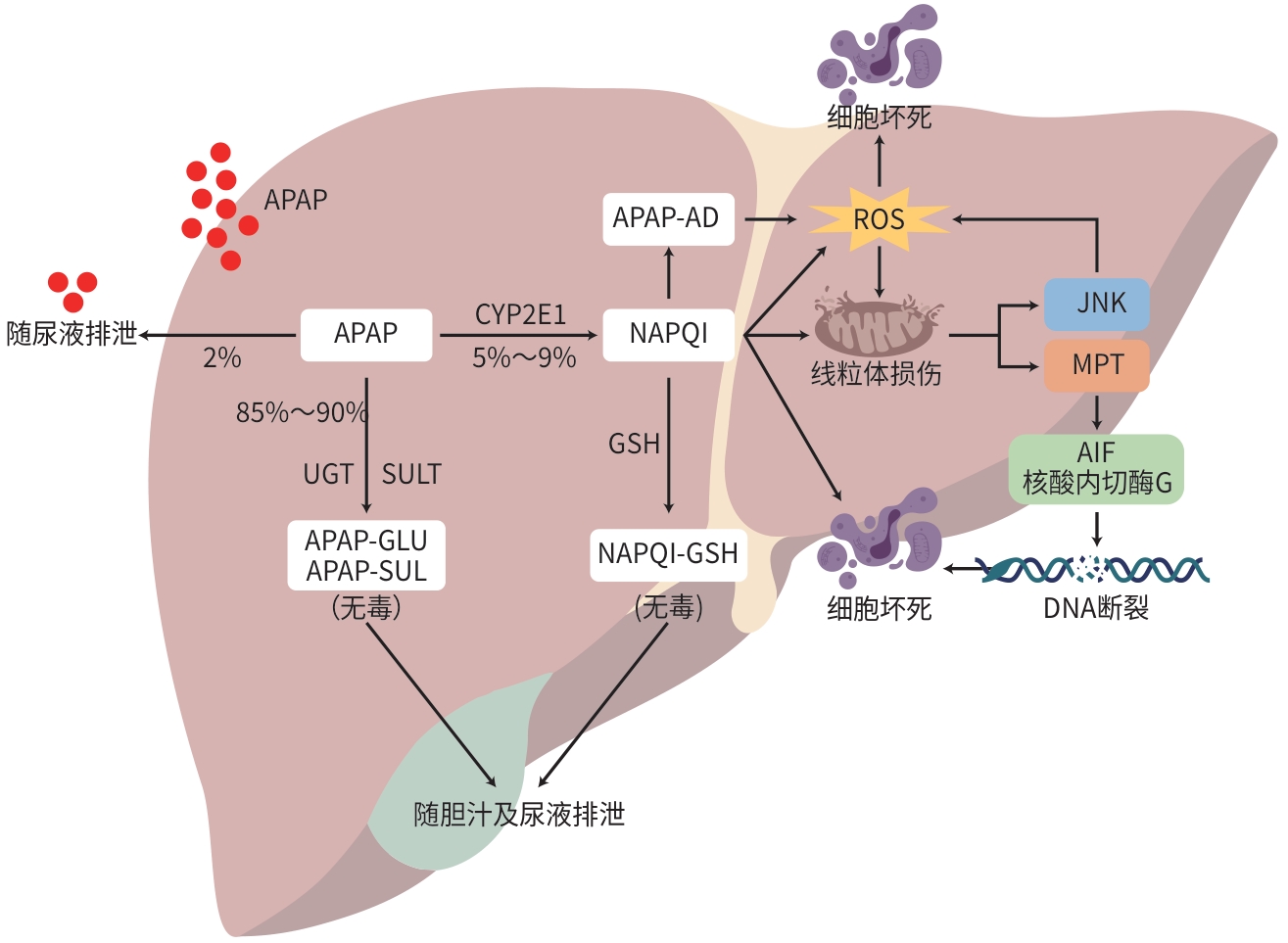




 DownLoad:
