

 PDF下载 ( 1410 KB)

肝癌干细胞可塑性的调控机制
DOI: 10.12449/JCH261033
利益冲突声明:本文不存在任何利益冲突。
作者贡献声明:郭会姬负责论文选题及撰写,文献资料分析;孟庆航负责论文校对;武雅荣、张照杰负责文献的收集和查重;于晓辉、郑英负责指导并修改论文。
-
摘要: 肝癌干细胞是肝细胞癌(HCC)中一类具有干细胞特性的亚群体,其细胞可塑性是维持HCC异质性和耐药性的关键因素。因此,深入了解肝癌干细胞的生物学特性并探索其可塑性机制,对于改善HCC患者的预后至关重要。本文系统综述了肝癌干细胞可塑性的核心调控机制,包括主要表面标志物的表达特征与信号通路的异常激活、表观遗传学、代谢重编程及肿瘤微环境等多种调控因素,旨在为HCC的精准治疗提供理论支持与新的方向。Abstract: Liver cancer stem cells (LCSCs) are a subpopulation with stem cell properties in hepatocellular carcinoma (HCC), and their cellular plasticity is a key factor for maintaining heterogeneity and drug resistance in HCC. Therefore, a deep understanding of the biological characteristics of LCSCs and exploration of the mechanisms underlying LCSC plasticity are crucial for improving the prognosis of HCC patients. This article systematically reviews the core regulatory mechanisms of LCSC plasticity, including the expression of major surface markers, abnormal activation of signaling pathways, epigenetics, metabolic reprogramming, and tumor microenvironment, in order to provide theoretical support and new directions for precise treatment of HCC.
-
Key words:
- Carcinoma, Hepatocellular /
- Neoplastic Stem Cells /
- Tumor Microenvironment
-
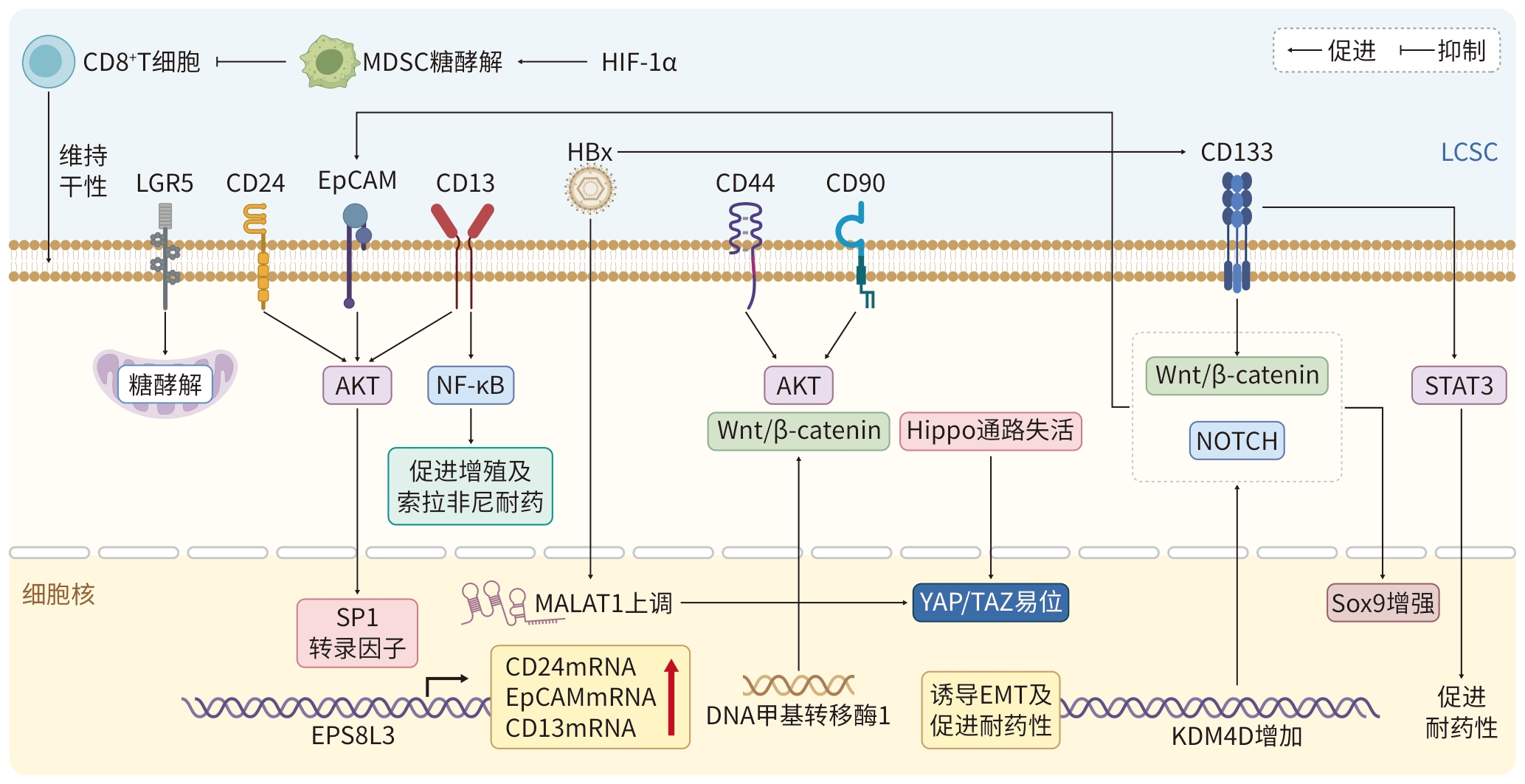
注: LCSC,肝癌干细胞;EpCAM,上皮细胞黏附分子;LGR5,G蛋白偶联受体5;MDSC,髓源性抑制细胞;NF-κB,核因子κB;EMT,上皮-间质转化;CD,分化抗原;HBx,乙型肝炎病毒X蛋白;Akt,蛋白激酶B;HIF-1α,缺氧诱导因子- 1α;SP1,特异性蛋白1;Sox9,SRY盒转录因子9;YAP,Yes相关蛋白1;TAZ,转录共激活因子PDZ 结合基序蛋白;NOTCH,Notch 信号通路;STAT3,信号转导与转录激活因子;Wnt/β-catenin,Wnt/β-联蛋白;EPS8L3,表皮生长因子受体激酶底物8样蛋白3;KDM4D,组蛋白赖氨酸去甲基化酶4D;MALAT1,转移相关肺腺癌转录本1。
图 1 LCSC可塑性的核心调控通路
Figure 1. Core regulatory pathways of LCSC plasticity
-
[1] Kwon M, Jung H J. Anticancer potential of myricetin against Huh7- and Hep3B-derived liver cancer stem cells through the regulation of apoptosis, autophagy, and stemness[J]. Biomol Ther, 2025, 33( 4): 636- 651. DOI: 10.4062/biomolther.2025.044. [2] Jin X S, Dong H J, Wang J, et al. HBx facilitates drug resistance in hepatocellular carcinoma via CD133-regulated self-renewal of liver cancer stem cells[J]. J Clin Transl Hepatol, 2025, 13( 1): 15- 24. DOI: 10.14218/JCTH.2024.00259. [3] Liu P, Zhang Q, Liu F C. Biological roles and clinical applications of EpCAM in HCC[J]. Discover Oncol, 2025, 16( 1): 319. DOI: 10.1007/s12672-025-02095-0. [4] Srikanth A, Rao R V A, Dong R, et al. Peptide-based inhibition of CD44v6 renders liver carcinomas more susceptible to therapeutic intervention[J]. J Mol Med(Berl), 2025, 103( 11-12): 1583- 1598. DOI: 10.1007/s00109-025-02601-5. [5] Cui Wenting, Liu Ningning, Ma Xiuzhen, et al. Role of liver cancer stem cells in hepatocellular carcinoma and related strategies for targeted therapy[J]. J Clin Hepatol, 2026, 42( 2): 457- 463. DOI: 10.12449/JCH260229.崔文婷, 刘宁宁, 马秀珍, 等. 肝癌干细胞在肝细胞癌中的作用和靶向治疗策略[J]. 临床肝胆病杂志, 2026, 42( 2): 457- 463. DOI: 10.12449/JCH260229. [6] Cai Y, Liu L Y, Xia X X, et al. Stemness CD24 activation promotes hepatocellular carcinoma progression via an immune escape mechanism[J]. World J Gastroenterol, 2026, 32( 3): 113187. DOI: 10.3748/wjg.v32.i3.113187. [7] Sugenoya S, Uehara T, Iwaya M, et al. LGR5 expression is associated with prognosis in high-grade hepatocellular carcinoma[J]. Int J Surg Pathol, 2026, 34( 2): 407- 415. DOI: 10.1177/10668969251384894. [8] Abuhassan Q, Allela O Q B, Kareem R A, et al. Liver cancer stem cells as novel diagnostic biomarkers[J]. Clin Chim Acta, 2026, 580: 120739. DOI: 10.1016/j.cca.2025.120739. [9] Zhang S, Feng X, Quan E, et al. CD133+ vesicles mediate resistance to RAS-ERK inhibition regulated by YAP activation in liver cancer cells[PP/OL]. bioRxiv( 2025-08-02). https://doi.org/10.1101/2025.07.31.667712. DOI: 10.1101/2025.07.31.667712 [10] Pan Y S, Zhang X, Wong C C, et al. Targeting cancer stem cells enhances multikinase inhibitor therapy in metabolic dysfunction-associated steatotic liver disease-related hepatocellular carcinoma[J]. Gut, 2026, 75( 9): 1786- 1800. DOI: 10.1136/gutjnl-2025-336527. [11] Xie P Y, Yan J L, Wu M Y, et al. CD44 potentiates hepatocellular carcinoma migration and extrahepatic metastases via the AKT/ERK signaling CXCR4 axis[J]. Ann Transl Med, 2022, 10( 12): 689. DOI: 10.21037/atm-22-2482. [12] Asakura N, Nakamura N, Muroi A, et al. Expression of cancer stem cell markers EpCAM and CD90 is correlated with anti- and pro-oncogenic EphA2 signaling in hepatocellular carcinoma[J]. Int J Mol Sci, 2021, 22( 16): 8652. DOI: 10.3390/ijms22168652. [13] Tsui Y M, Ho D W, Sze K M, et al. Sorted-cell sequencing on HCC specimens reveals EPS8L3 as a key player in CD24/CD13/EpCAM-triple positive, stemness-related HCC cells[J]. Cell Mol Gastroenterol Hepatol, 2024, 18( 3): 101358. DOI: 10.1016/j.jcmgh.2024.05.006. [14] Liu D, Li H, Dong H, et al. Spatial multiomics analysis reveals only minor genetic and epigenetic changes in human liver cancer stem-like cells compared with other tumor parenchymal cells[J]. Front Cell Dev Biol, 2022, 10: 810687. DOI: 10.3389/fcell.2022.810687. [15] Cheng C C Y, Cheung M F, Lee A Y, et al. Multi-omic analysis of hepatocellular carcinoma reveals aberrant cis-regulatory changes and dysregulated retrotransposons with prognostic potential[J]. Commun Biol, 2025, 8( 1): 1792. DOI: 10.1038/s42003-025-09154-w. [16] Cao X C, Liu L H, Cao X Z, et al. The DNMT1/miR-34a/FOXM1 axis contributes to stemness of liver cancer cells[J]. J Oncol, 2020, 2020( 1): 8978930. DOI: 10.1155/2020/8978930. [17] Wang Q, Liang N, Yang T, et al. DNMT1-mediated methylation of BEX1 regulates stemness and tumorigenicity in liver cancer[J]. J Hepatol, 2021, 75( 5): 1142- 1153. DOI: 10.1016/j.jhep.2021.06.025. [18] Jan Z, Ahmed W S, Biswas K H, et al. Identification of a potential DNA methyltransferase(DNMT) inhibitor[J]. J Biomol Struct Dyn, 2024, 42( 9): 4730- 4744. DOI: 10.1080/07391102.2023.2233637. [19] Al Ojaimi M, Banimortada B J, Alragheb A, et al. Molecular and clinical aspects of histone-related disorders[J]. Hum Genom, 2025, 19( 1): 47. DOI: 10.1186/s40246-025-00734-9. [20] Maemoto Y, Shimizu Y, Katoh R, et al. Naturally occurring small molecule compounds that target histone deacetylases and their potential applications in cancer therapy[J]. J Antibiot, 2021, 74( 10): 667- 676. DOI: 10.1038/s41429-021-00459-6. [21] Chen J X, Xu Z J, Huang H B, et al. SETD1A drives stemness by reprogramming the epigenetic landscape in hepatocellular carcinoma stem cells[J]. JCI Insight, 2023, 8( 18): e168375. DOI: 10.1172/jci.insight.168375. [22] Liu Z J, Han J Q, Su S T, et al. Histone lactylation facilitates MCM7 expression to maintain stemness and radio-resistance in hepatocellular carcinoma[J]. Biochem Pharmacol, 2025, 236: 116887. DOI: 10.1016/j.bcp.2025.116887. [23] Deng Y, Li M, Zhuo M H, et al. Histone demethylase JMJD2D promotes the self-renewal of liver cancer stem-like cells by enhancing EpCAM and Sox9 expression[J]. J Biol Chem, 2021, 296: 100121. DOI: 10.1074/jbc.RA120.015335. [24] Pan L H, Feng F, Wu J Q, et al. Demethylzeylasteral targets lactate by inhibiting histone lactylation to suppress the tumorigenicity of liver cancer stem cells[J]. Pharmacol Res, 2022, 181: 106270. DOI: 10.1016/j.phrs.2022.106270. [25] Ma S, Cheng J P, Wang H Y, et al. A novel regulatory loop miR-101/ANXA2/EGR1 mediates malignant characteristics of liver cancer stem cells[J]. Carcinogenesis, 2021, 42( 1): 93- 104. DOI: 10.1093/carcin/bgaa055. [26] Pei R F, Zhao L, Ding Y R, et al. JMJD6-BRD4 complex stimulates lncRNA HOTAIR transcription by binding to the promoter region of HOTAIR and induces radioresistance in liver cancer stem cells[J]. J Transl Med, 2023, 21( 1): 752. DOI: 10.1186/s12967-023-04394-y. [27] Zhao L Y, Lou G H, Li A C, et al. lncRNA MALAT1 modulates cancer stem cell properties of liver cancer cells by regulating YAP1 expression via miR-375 sponging[J]. Mol Med Rep, 2020, 22( 2): 1449- 1457. DOI: 10.3892/mmr.2020.11196. [28] Li X C, Kong D L, Hu W, et al. Insight into the mechanisms regulating liver cancer stem cells by hepatitis B virus X protein[J]. Infect Agents Cancer, 2024, 19( 1): 56. DOI: 10.1186/s13027-024-00618-y. [29] Yang S Z, Ruan X J, Hu B R, et al. lncRNA SNHG9 enhances liver cancer stem cell self-renewal and tumorigenicity by negatively regulating PTEN expression via recruiting EZH2[J]. Cell Tissue Res, 2023, 394( 3): 441- 453. DOI: 10.1007/s00441-023-03834-x. [30] Lv G S, Zong Q N, Wang L, et al. LGR5/mTORC2 axis regulates cellular metabolic plasticity to maintain tumorigenesis in hepatocellular carcinoma[J]. Cancer Lett, 2026, 636: 217978. DOI: 10.1016/j.canlet.2025.217978. [31] Liu J C, Wu X Q, Yin Q S, et al. HBx drives liver cancer stem cell generation through stimulating glucose metabolic reprogramming[J]. J Cell Mol Med, 2025, 29( 14): e70722. DOI: 10.1111/jcmm.70722. [32] Chen Y Y, Wang W H, Che L, et al. BNIP3L-dependent mitophagy promotes HBx-induced cancer stemness of hepatocellular carcinoma cells via glycolysis metabolism reprogramming[J]. Cancers, 2020, 12( 3): 655. DOI: 10.3390/cancers12030655. [33] Luo J, Gong L Q, Yang Y M, et al. Enhanced mitophagy driven by ADAR1-GLI1 editing supports the self-renewal of cancer stem cells in HCC[J]. Hepatology, 2024, 79( 1): 61- 78. DOI: 10.1097/hep.0000000000000299. [34] Yang S, Ko M, Zhang W, et al. Splicing factor SF3B4 promotes mitochondrial glutamine metabolism in hepatocellular carcinoma by regulating GLS1 isoform switching[J]. Biochem Biophys Res Commun, 2026, 796: 153134. DOI: 10.1016/j.bbrc.2025.153134. [35] Guo Z Q, Huang Y Y, Dong X L, et al. Hypoxia-Induced M6A modification via YTHDF2 stabilizes PFKL to fuel MDSC Glycolysis and hepatocellular carcinoma progression[J]. Funct Integr Genom, 2025, 25( 1): 238. DOI: 10.1007/s10142-025-01743-6. [36] Kao T W, Chuang Y C, Lee H L, et al. Therapeutic targeting of glutaminolysis as a novel strategy to combat cancer stem cells[J]. Int J Mol Sci, 2022, 23( 23): 15296. DOI: 10.3390/ijms232315296. [37] Li H Q, Song J J, He Y F, et al. CRISPR/Cas9 screens reveal that hexokinase 2 enhances cancer stemness and tumorigenicity by activating the ACSL4-fatty acid β-oxidation pathway[J]. Adv Sci(Weinh), 2022, 9( 21): e2105126. DOI: 10.1002/advs.202105126. [38] Sun L, Zhang L, Chen J, et al. Activation of tyrosine metabolism in CD13+ cancer stem cells drives relapse in hepatocellular carcinoma[J]. Cancer Res Treat, 2020, 52( 2): 604- 621. DOI: 10.4143/crt.2019.444. [39] Feng F, Wu J Q, Chi Q J, et al. Lactylome analysis unveils lactylation-dependent mechanisms of stemness remodeling in the liver cancer stem cells[J]. Adv Sci, 2024, 11( 38): 2405975. DOI: 10.1002/advs.202405975. [40] Yin Y C, He J, Feng Y, et al. FiLactate-induced lysine lactylation: A central node linking metabolic rewiring, epigenetic plasticity and therapeutic vulnerabilities in hepatocellular carcinoma[J]. J Biochem Mol Toxicol, 2025, 39( 12): e70622. DOI: 10.1002/jbt.70622. [41] Roy S K, Srivastava R, Landry N, et al. Regulation of autophagy and metabolism in hepatocellular carcinoma: Involvement of wnt-β- catenin pathway[J]. J Cell Mol Med, 2026, 30( 5): e71070. DOI: 10.1111/jcmm.71070. [42] Ghaboura N. Unraveling the Hippo pathway: YAP/TAZ as central players in cancer metastasis and drug resistance[J]. EXCLI J, 2025, 24: 612- 637. DOI: 10.17179/excli2025-8351. [43] Nishina H. Physiological and pathological roles of the Hippo-YAP/TAZ signaling pathway in liver formation, homeostasis, and tumorigenesis[J]. Cancer Sci, 2022, 113( 6): 1900- 1908. DOI: 10.1111/cas.15352. [44] Wang Q, Li S Y, Xu C, et al. A novel lonidamine derivative targeting mitochondria to eliminate cancer stem cells by blocking glutamine metabolism[J]. Pharmacol Res, 2023, 190: 106740. DOI: 10.1016/j.phrs.2023.106740. [45] Li H, Sun Y C, Li Q, et al. Matrix stiffness potentiates stemness of liver cancer stem cells possibly via the yes-associated protein signal[J]. ACS Biomater Sci Eng, 2022, 8( 2): 598- 609. DOI: 10.1021/acsbiomaterials.1c00558. [46] Yan W, Xiao G H, Wang L J, et al. CAFs activated by YAP1 upregulate cancer matrix stiffness to mediate hepatocellular carcinoma progression[J]. J Transl Med, 2025, 23( 1): 450. DOI: 10.1186/s12967-025-06325-5. [47] Li H Q, Zhang J Y, Shi Y, et al. Identification of matrix stiffness-related molecular subtypes in HCC via integrating multi-omics analysis and machine learning algorithms[J]. J Transl Med, 2025, 23( 1): 716. DOI: 10.1186/s12967-025-06733-7. [48] Ma D, Luo Q, Song G B. Matrix stiffening facilitates stemness of liver cancer stem cells by YAP activation and BMF inhibition[J]. Biomater Adv, 2024, 163: 213936. DOI: 10.1016/j.bioadv.2024.213936. [49] Wang M, Xu Y N, Meng Y B, et al. Stiffness-activated hepatic stellate cells boost HCC migration via TGM2/ITGB1-mediated matrix remodeling and mitochondrial transfer[J]. JHEP Rep, 2025, 7( 10): 101484. DOI: 10.1016/j.jhepr.2025.101484. [50] Deng X, Li X Y, Guo X, et al. Myeloid-derived suppressor cells promote tumor growth and sorafenib resistance by inducing FGF1 upregulation and fibrosis[J]. Neoplasia, 2022, 28: 100788. DOI: 10.1016/j.neo.2022.100788. [51] Peng H, Yang M, Feng K, et al. Semaphorin 3C(Sema3C) reshapes stromal microenvironment to promote hepatocellular carcinoma progression[J]. Sig Transduct Target Ther, 2024, 9( 1): 169. DOI: 10.1038/s41392-024-01887-0. [52] Nian Z G, Dou Y C, Shen Y Q, et al. Interleukin-34-orchestrated tumor-associated macrophage reprogramming is required for tumor immune escape driven by p53 inactivation[J]. Immunity, 2024, 57( 10): 2344- 2361.e7. DOI: 10.1016/j.immuni.2024.08.015. [53] Gan L B, Lu T, Lu Y, et al. Endosialin-positive CAFs promote hepatocellular carcinoma progression by suppressing CD8+ T cell infiltration[J]. J Immunother Cancer, 2024, 12( 9): e009111. DOI: 10.1136/jitc-2024-009111. [54] Nosaka T, Murata Y, Takahashi K, et al. Hepatocellular carcinoma progression promoted by 5-lipoxygenase activity in CD163+ tumor-associated macrophages[J]. Biomed Pharmacother, 2023, 162: 114592. DOI: 10.1016/j.biopha.2023.114592. [55] Jing S Y, Liu D, Feng N, et al. Spatial multiomics reveals a subpopulation of fibroblasts associated with cancer stemness in human hepatocellular carcinoma[J]. Genome Med, 2024, 16( 1): 98. DOI: 10.1186/s13073-024-01367-8. [56] Ng K Y, Shea Q T, Wong T L, et al. Chemotherapy-enriched THBS2-deficient cancer stem cells drive hepatocarcinogenesis through matrix softness induced histone H3 modifications[J]. Adv Sci(Weinh), 2021, 8( 5): 2002483. DOI: 10.1002/advs.202002483. [57] Wang X, Zhao Y B, Li X, et al. Liposomal STAT3-degrading PROTAC prodrugs promote anti-hepatocellular carcinoma immunity via chemically reprogramming cancer stem cells[J]. Nano Lett, 2024, 24( 16): 4858- 4868. DOI: 10.1021/acs.nanolett.4c00201. -

 下载:
 本文二维码
图(1)
计量
- 文章访问数: 13
- HTML全文浏览量: 9
- PDF下载量: 1
- 被引次数: 0


