

 PDF下载 ( 1344 KB)

慢性肝病背景下药物性肝损伤的鉴别与治疗
DOI: 10.12449/JCH261008
利益冲突声明:本文不存在任何利益冲突。
作者贡献声明:刘哲睿负责文献检索、整理与归纳、文章构思、初稿撰写、图表制作及稿件修改;孙颖负责文章构思与内容审阅;邹正升负责文章总体设计与构思、内容审阅及最终定稿。
Recognition and treatment of drug-induced liver injury in the setting of chronic liver disease
-
摘要: 药物性肝损伤(DILI)是药物、草药或膳食补充剂暴露后发生的肝损伤,临床表现可由肝生化异常进展至肝衰竭。DILI缺乏特异性诊断标志物,需结合药物暴露、停药后的肝功能变化和竞争病因来进行判断。当DILI发生于肝硬化等慢性肝病患者时,尤其伴失代偿或肝功能储备明显受损,或发生于肝细胞癌系统治疗过程中,基线异常、复杂病因和有限肝功能储备进一步增加其识别和处理难度。近年来,研究逐渐关注慢性肝病背景下DILI的病因鉴别、判定标准以及风险模型和干预证据的适用性。本文结合近年来的主要临床研究,对慢性肝病背景下DILI的识别与归因、风险预测及治疗进展进行归纳与评述。
-
关键词:
- 化学性与药物性肝损伤 /
- 肝硬化 /
- 慢加急性肝功能衰竭 /
- 诊断 /
- 治疗学
Abstract: Drug-induced liver injury (DILI) refers to liver injury caused by medications, herbal products, or dietary supplements, with clinical manifestations ranging from abnormalities in liver biochemistry to liver failure. Since there is a lack of specific markers for the diagnosis of DILI, it is necessary to combine various factors such as drug exposure, the change in liver function after drug withdrawal, and competing etiologies to make a judgment. When DILI occurs in patients with chronic liver diseases such as liver cirrhosis, especially in those with decompensation or markedly impaired hepatic reserve or during systemic therapy for hepatocellular carcinoma, abnormalities at baseline, complex etiologies, and limited hepatic reserve can further increase the difficulties in identification and treatment. In recent years, studies on DILI in the context of chronic liver disease have gradually focused on the etiological differentiation, diagnostic criteria, and the applicability of risk models and intervention evidence. With reference to major clinical studies in recent years, this article summarizes and reviews the identification and attribution of DILI, risk prediction, and treatment advances in the setting of chronic liver disease. -
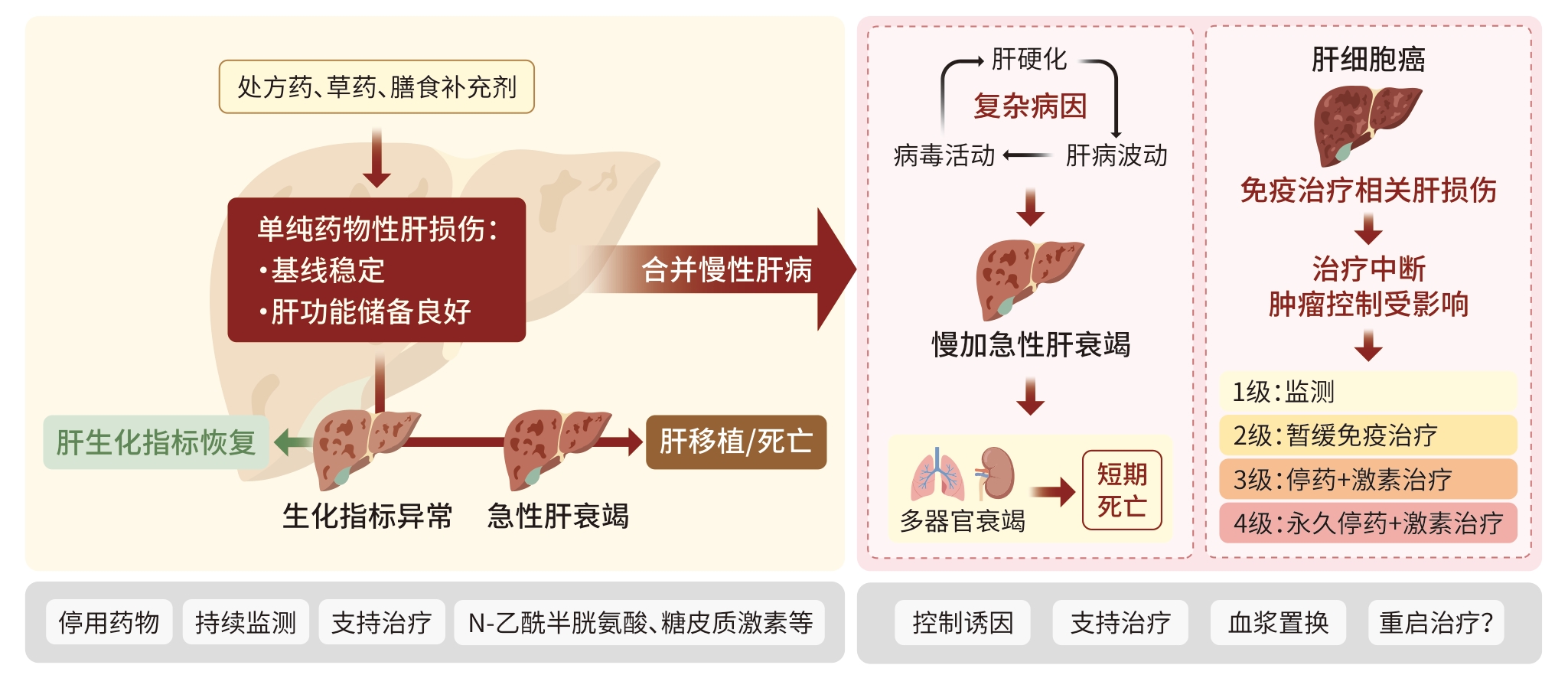
图 1 慢性肝病背景下药物性肝损伤的临床特点、结局及处理
Figure 1. Clinical features, outcomes, and management of drug-induced liver injury in the setting of chronic liver disease
表 1 慢性肝病相关DILI的风险评估工具及预测效能
Table 1. Risk assessment tools and predictive efficacy for DILI associated with chronic liver disease
模型 研究对象 主要变量 预测结局 AUC AARC评分[11, 43] 329例药物诱发ACLF患者 TBil、INR、肌酐、乳酸、肝性脑病 90天死亡 0.75 MELD评分[11] 329例药物诱发ACLF患者 TBil、INR、肌酐 90天死亡 0.74 CLIF-C OF评分[13] 30例肝硬化合并可能由补充与替代医
学制剂相关DILI所致的ACLF患者肝、肾、脑、凝血、循环及呼吸功能 1个月死亡 0.861 DILI慢性化模型[44] 114例DILI患者,其中27例合并慢性乙
型肝炎病毒感染;排除肝硬化及HCC乙型肝炎病毒表面抗原状态、基线
天冬氨酸氨基转移酶>200 U/L、TBil>
34.2 μmol/L6个月时DILI
慢性化0.814 HCC-irLI发生模型[42] 207例接受ICI治疗的HCC患者 糖尿病、肝硬化、肿瘤结节数量≥3个 ICI治疗期间
irLI的发生0.701 注:DILI,药物性肝损伤;HCC,肝细胞癌;ICI,免疫检查点抑制剂;irLI,免疫治疗相关肝损伤;TBil,总胆红素;INR,国际标准化比值;ACLF,慢加急性肝衰竭;AARC,亚太肝病学会ACLF研究联盟;MELD,终末期肝病模型;CLIF-C OF,慢性肝衰竭联盟器官衰竭评分;AUC,曲线下面积。
 下载: 导出CSV
-
[1] Fontana R J, Liou I, Reuben A, et al. AASLD practice guidance on drug, herbal, and dietary supplement-induced liver injury[J]. Hepatology, 2023, 77( 3): 1036- 1065. DOI: 10.1002/hep.32689. [2] Mao Y M, Ma S W, Liu C H, et al. Chinese guideline for the diagnosis and treatment of drug-induced liver injury: An update[J]. Hepatol Int, 2024, 18( 2): 384- 419. DOI: 10.1007/s12072-023-10633-7. [3] Andrade R J, Aithal G P, Björnsson E S, et al. EASL clinical practice guidelines: Drug-induced liver injury[J]. J Hepatol, 2019, 70( 6): 1222- 1261. DOI: 10.1016/j.jhep.2019.02.014. [4] Chalasani N P, Maddur H, Russo M W, et al. ACG clinical guideline: Diagnosis and management of idiosyncratic drug-induced liver injury[J]. Am J Gastroenterol, 2021, 116( 5): 878- 898. DOI: 10.14309/ajg.0000000000001259. [5] Devarbhavi H, Aithal G, Treeprasertsuk S, et al. Drug-induced liver injury: Asia Pacific Association of Study of Liver consensus guidelines[J]. Hepatol Int, 2021, 15( 2): 258- 282. DOI: 10.1007/s12072-021-10144-3. [6] Fontana R J, Bjornsson E S, Reddy R, et al. The evolving profile of idiosyncratic drug-induced liver injury[J]. Clin Gastroenterol Hepatol, 2023, 21( 8): 2088- 2099. DOI: 10.1016/j.cgh.2022.12.040. [7] Ghabril M, Vuppalanchi R, Chalasani N. Drug-induced liver injury in patients with chronic liver disease[J]. Liver Int, 2025, 45( 3): e70019. DOI: 10.1111/liv.70019. [8] Devarbhavi H C, Philips C A. Drug-induced liver injury in patients with underlying liver disease[J]. Clin Liver Dis, 2024, 23( 1): e0189. DOI: 10.1097/cld.0000000000000189. [9] Chalasani N, Bonkovsky H L, Fontana R, et al. Features and outcomes of 899 patients with drug-induced liver injury: The DILIN prospective study[J]. Gastroenterology, 2015, 148( 7): 1340- 1352.e7. DOI: 10.1053/j.gastro.2015.03.006. [10] Chirapongsathorn S, Sukeepaisarnjaroen W, Treeprasertsuk S, et al. Characteristics of drug-induced liver injury in chronic liver disease: Results from the Thai association for the study of the liver(THASL) DILI registry[J]. J Clin Transl Hepatol, 2023, 11( 1): 88- 96. DOI: 10.14218/JCTH.2021.00479. [11] Devarbhavi H, Choudhury A K, Sharma M K, et al. Drug-induced acute-on-chronic liver failure in Asian patients[J]. Am J Gastroenterol, 2019, 114( 6): 929- 937. DOI: 10.14309/ajg.0000000000000201. [12] Ma J Y, Ghabril M, Chalasani N. Drug-induced acute-on-chronic liver failure: Challenges and future directions[J]. Clin Liver Dis, 2023, 27( 3): 631- 648. DOI: 10.1016/j.cld.2023.03.007. [13] Philips C A, Paramaguru R, Augustine P, et al. A single-center experience on outcomes of complementary and alternative medicine use among patients with cirrhosis[J]. Hepatol Commun, 2019, 3( 7): 1001- 1012. DOI: 10.1002/hep4.1355. [14] Kumar A, Arora A, Choudhury A, et al. Impact of diabetes, drug-induced liver injury, and sepsis on outcomes in metabolic dysfunction associated fatty liver disease-related acute-on-chronic liver failure[J]. Am J Gastroenterol, 2025, 120( 4): 816- 826. DOI: 10.14309/ajg.0000000000002951. [15] Huang Y S, Tseng S Y, Chen W W, et al. Clinical characteristics and outcomes of drug-induced liver injury in Taiwan: With emphasis on the impact of chronic hepatitis B infection[J]. J Chin Med Assoc, 2022, 85( 3): 286- 294. DOI: 10.1097/JCMA.0000000000000648. [16] Treem W R, Palmer M, Lonjon-Domanec I, et al. Consensus guidelines: Best practices for detection, assessment and management of suspected acute drug-induced liver injury during clinical trials in adults with chronic viral hepatitis and adults with cirrhosis secondary to hepatitis B, C and nonalcoholic steatohepatitis[J]. Drug Saf, 2021, 44( 2): 133- 165. DOI: 10.1007/s40264-020-01014-2. [17] Wang Y, Liu L W, Zhao M Y, et al. The higher incidence of liver injury in HCC patients compared to other malignancies during immune-checkpoint inhibitor therapy is primarily due to tumor progression[J]. Ther Clin Risk Manag, 2025, 21: 963- 974. DOI: 10.2147/TCRM.S514868. [18] Finn R S, Qin S K, Ikeda M, et al. Atezolizumab plus bevacizumab in unresectable hepatocellular carcinoma[J]. N Engl J Med, 2020, 382( 20): 1894- 1905. DOI: 10.1056/NEJMoa1915745. [19] Cheng A L, Qin S K, Ikeda M, et al. Updated efficacy and safety data from IMbrave150: Atezolizumab plus bevacizumab vs. Sorafenib for unresectable hepatocellular carcinoma[J]. J Hepatol, 2022, 76( 4): 862- 873. DOI: 10.1016/j.jhep.2021.11.030. [20] Abou-Alfa G K, Lau G, Kudo M, et al. Tremelimumab plus durvalumab in unresectable hepatocellular carcinoma[J]. NEJM Evid, 2022, 1( 8): EVIDoa2100070. DOI: 10.1056/EVIDoa2100070. [21] Celsa C, Cabibbo G, Fulgenzi C A M, et al. Characteristics and outcomes of immunotherapy-related liver injury in patients with hepatocellular carcinoma versus other advanced solid tumours[J]. J Hepatol, 2024, 80( 3): 431- 442. DOI: 10.1016/j.jhep.2023.10.040. [22] Ennin E, Mallepally N, Ali M, et al. High grade hepatotoxicity from dual checkpoint inhibitors is more common in hepatocellular carcinoma than other cancers[J]. Liver Int, 2025, 45( 9): e70255. DOI: 10.1111/liv.70255. [23] Kudo M, Matilla A, Santoro A, et al. CheckMate 040 cohort 5: A phase I/II study of nivolumab in patients with advanced hepatocellular carcinoma and Child-Pugh B cirrhosis[J]. J Hepatol, 2021, 75( 3): 600- 609. DOI: 10.1016/j.jhep.2021.04.047. [24] D’Alessio A, Fulgenzi C A M, Nishida N, et al. Preliminary evidence of safety and tolerability of atezolizumab plus bevacizumab in patients with hepatocellular carcinoma and Child-Pugh A and B cirrhosis: A real-world study[J]. Hepatology, 2022, 76( 4): 1000- 1012. DOI: 10.1002/hep.32468. [25] Feldman T C, Kaplan D E, Lin A, et al. Phenotyping hepatic immune-related adverse events in the setting of immune checkpoint inhibitor therapy[J]. JCO Clin Cancer Inform, 2024, 8: e2300159. DOI: 10.1200/CCI.23.00159. [26] Zhao S X, Li J, Liu L D, et al. Consensus on the management of liver injury associated with targeted drugs and immune checkpoint inhibitors for hepatocellular carcinoma(version 2024)[J]. J Clin Transl Hepatol, 2025, 13( 11): 992- 1005. DOI: 10.14218/JCTH.2025.00228. [27] Sangro B, Chan S L, Meyer T, et al. Diagnosis and management of toxicities of immune checkpoint inhibitors in hepatocellular carcinoma[J]. J Hepatol, 2020, 72( 2): 320- 341. DOI: 10.1016/j.jhep.2019.10.021. [28] Peeraphatdit T B, Wang J, Odenwald M A, et al. Hepatotoxicity from immune checkpoint inhibitors: A systematic review and management recommendation[J]. Hepatology, 2020, 72( 1): 315- 329. DOI: 10.1002/hep.31227. [29] Shamseddeen H, Vilar-Gomez E, Chalasani N, et al. Spontaneous fluctuations in liver biochemistries in patients with compensated NASH cirrhosis: Implications for drug hepatotoxicity monitoring[J]. Drug Saf, 2020, 43( 3): 281- 290. DOI: 10.1007/s40264-019-00896-1. [30] Tesfaldet B, Patel T, Chen M J, et al. Composite plot for visualizing aminotransferase and bilirubin changes in clinical trials of subjects with abnormal baseline values[J]. Drug Saf, 2024, 47( 7): 699- 710. DOI: 10.1007/s40264-024-01425-5. [31] Amirzadegan J, Tesfaldet B, Pei Y V, et al. Emerging tools to support DILI assessment in clinical trials with abnormal baseline serum liver tests or pre-existing liver diseases[J]. Drug Saf, 2025, 48( 5): 443- 453. DOI: 10.1007/s40264-024-01511-8. [32] Merz M, Fettiplace A, Marcinak J, et al. Liver toxicity in oncology trials and beyond: A simplified concept for management of hepatocellular drug-induced liver injury in patients with abnormal baseline liver tests[J]. Expert Opinion on Drug Safety, 2024, 23( 4): 527- 537. DOI: 10.1080/14740338.2024.2327509. [33] Hayashi P H. Drug-induced liver injury network causality assessment: Criteria and experience in the United States[J]. Int J Mol Sci, 2016, 17( 2): 201. DOI: 10.3390/ijms17020201. [34] Ahmad J, Reddy K R, Tillmann H L, et al. Importance of hepatitis C virus RNA testing in patients with suspected drug-induced liver injury[J]. Dig Dis Sci, 2019, 64( 9): 2645- 2652. DOI: 10.1007/s10620-019-05591-w. [35] Hayashi P H, Lucena M I, Fontana R J, et al. A revised electronic version of RUCAM for the diagnosis of DILI[J]. Hepatology, 2022, 76( 1): 18- 31. DOI: 10.1002/hep.32327. [36] Palmer M, Kleiner D E, Goodman Z, et al. Liver biopsy for assessment of suspected drug-induced liver injury in metabolic dysfunction-associated steatohepatitis clinical trials: Expert consensus from the Liver Forum[J]. Aliment Pharmacol Ther, 2024, 59( 2): 201- 216. DOI: 10.1111/apt.17762. [37] Lo Re V, Haynes K, Forde K A, et al. Risk of acute liver failure in patients with drug-induced liver injury: Evaluation of hy’s law and a new prognostic model[J]. Clin Gastroenterol Hepatol, 2015, 13( 13): 2360- 2368. DOI: 10.1016/j.cgh.2015.06.020. [38] Ghabril M, Gu J Z, Yoder L, et al. Development and validation of a model consisting of comorbidity burden to calculate risk of death within 6 months for patients with suspected drug-induced liver injury[J]. Gastroenterology, 2019, 157( 5): 1245- 1252.e3. DOI: 10.1053/j.gastro.2019.07.006. [39] Likhitsup A, Su Z M, Rule J A, et al. The DILI-inpt prognostic score to identify hospitalized idiosyncratic DILI patients at risk for adverse outcomes[J]. Clin Gastroenterol Hepatol, 2026, 24( 7): 1867- 1876. DOI: 10.1016/j.cgh.2025.11.004. [40] European Association for the Study of the Liver. EASL clinical practice guidelines on acute-on-chronic liver failure[J]. J Hepatol, 2023, 79( 2): 461- 491. DOI: 10.1016/j.jhep.2023.04.021. [41] Jalan R, Pavesi M, Saliba F, et al. The CLIF Consortium Acute Decompensation score(CLIF-C ADs) for prognosis of hospitalised cirrhotic patients without acute-on-chronic liver failure[J]. J Hepatol, 2015, 62( 4): 831- 840. DOI: 10.1016/j.jhep.2014.11.012. [42] Li X Y, Sun H, Wang J L, et al. Predicting the occurrence of liver injury induced by immune checkpoint inhibitors in hepatocellular carcinoma patients: A retrospective analysis[J]. BMC Cancer, 2025, 25( 1): 1123. DOI: 10.1186/s12885-025-14540-y. [43] Choudhury A, Jindal A, Maiwall R, et al. Liver failure determines the outcome in patients of acute-on-chronic liver failure(ACLF): Comparison of APASL ACLF research consortium(AARC) and CLIF-SOFA models[J]. Hepatol Int, 2017, 11( 5): 461- 471. DOI: 10.1007/s12072-017-9816-z. [44] Lin Y J, Xu M J, Yi W, et al. Analysis of clinical characteristics and chronic factors of drug-induced liver injury in chronic hepatitis B infection: A retrospective study[J]. Hepat Mon, 2021, 21( 9): e119328. DOI: 10.5812/hepatmon.119328. [45] Shingina A, Mukhtar N, Wakim-Fleming J, et al. Acute liver failure guidelines[J]. Am J Gastroenterol, 2023, 118( 7): 1128- 1153. DOI: 10.14309/ajg.0000000000002340. [46] Lee W M, Hynan L S, Rossaro L, et al. Intravenous N-acetylcysteine improves transplant-free survival in early stage non-acetaminophen acute liver failure[J]. Gastroenterology, 2009, 137( 3): 856- 864, 864.e 1. DOI: 10.1053/j.gastro.2009.06.006. [47] Song F J, Liu H L, Sun Y, et al. Prednisolone therapy accelerates recovery of severe drug-induced liver injury: A prospective, randomized controlled study[J]. iLIVER, 2023, 2( 3): 156- 162. DOI: 10.1016/j.iliver.2023.06.001. [48] Wan Y M, Wu J F, Li Y H, et al. Prednisone is not beneficial for the treatment of severe drug-induced liver injury: An observational study(STROBE compliant)[J]. Medicine, 2019, 98( 26): e15886. DOI: 10.1097/MD.0000000000015886. [49] Niu H, Ma J Y, Medina-Caliz I, et al. Potential benefit and lack of serious risk from corticosteroids in drug-induced liver injury: An international, multicentre, propensity score-matched analysis[J]. Aliment Pharmacol Ther, 2023, 57( 8): 886- 896. DOI: 10.1111/apt.17373. [50] Benić M S, Nežić L, Vujić-Aleksić V, et al. Novel therapies for the treatment of drug-induced liver injury: A systematic review[J]. Front Pharmacol, 2021, 12: 785790. DOI: 10.3389/fphar.2021.785790. [51] Karvellas C J, Bajaj J S, Kamath P S, et al. AASLD practice guidance on acute-on-chronic liver failure and the management of critically ill patients with cirrhosis[J]. Hepatology, 2024, 79( 6): 1463- 1502. DOI: 10.1097/HEP.0000000000000671. [52] Meunier L, Monet C, Saviano A, et al. Plasma exchange as potential treatment of severe immune checkpoint inhibitor-induced hepatitis[J]. JHEP Rep, 2026, 8( 3): 101684. DOI: 10.1016/j.jhepr.2025.101684. -

 本文二维码
图(1) / 表(1)
计量
- 文章访问数: 17
- HTML全文浏览量: 3
- PDF下载量: 3
- 被引次数: 0


