

 PDF下载 ( 1175 KB)

抗结核药物性肝损伤的临床表型与诊治
DOI: 10.12449/JCH261004
利益冲突声明:本文不存在任何利益冲突。
作者贡献声明:马雨婷、王雪负责文献查阅和撰写论文;于乐成拟定思路、指导撰写和修改定稿。
Clinical phenotypes, diagnosis, and treatment of anti-tuberculosis drug-induced liver injury
-
摘要: 抗结核药物性肝损伤(ATB-DILI)是导致抗结核治疗中断最常见的原因,其处置需充分考虑肝损伤加重与结核病进展之间的平衡。本文从抗结核联合用药整体视角,系统扼要地阐述了ATB-DILI的致病药物、风险因素、发病机制、临床表型、防治原则等相关进展,旨在为ATB-DILI的临床合理处置提供重要参考。
-
关键词:
- 化学性与药物性肝损伤 /
- 抗结核药 /
- 诊断 /
- 药物疗法
Abstract: Anti-tuberculosis drug-induced liver injury (ATB-DILI) is the most common cause for the interruption of anti-tuberculosis treatment, and its management requires a careful balance between the aggravation of liver injury and the progression of tuberculosis. From the overall perspective of the combined anti-tuberculosis therapies, this article systematically and concisely elaborates on the advances in ATB-DILI in terms of causative drugs, risk factors, pathogenic mechanisms, clinical phenotypes, and prevention and treatment principles, so as to provide an important reference for the rational clinical management of ATB-DILI.-
Key words:
- Chemical and Drug Induced Liver Injury /
- Antitubercular Agents /
- Diagnosis /
- Drug Therapy
-
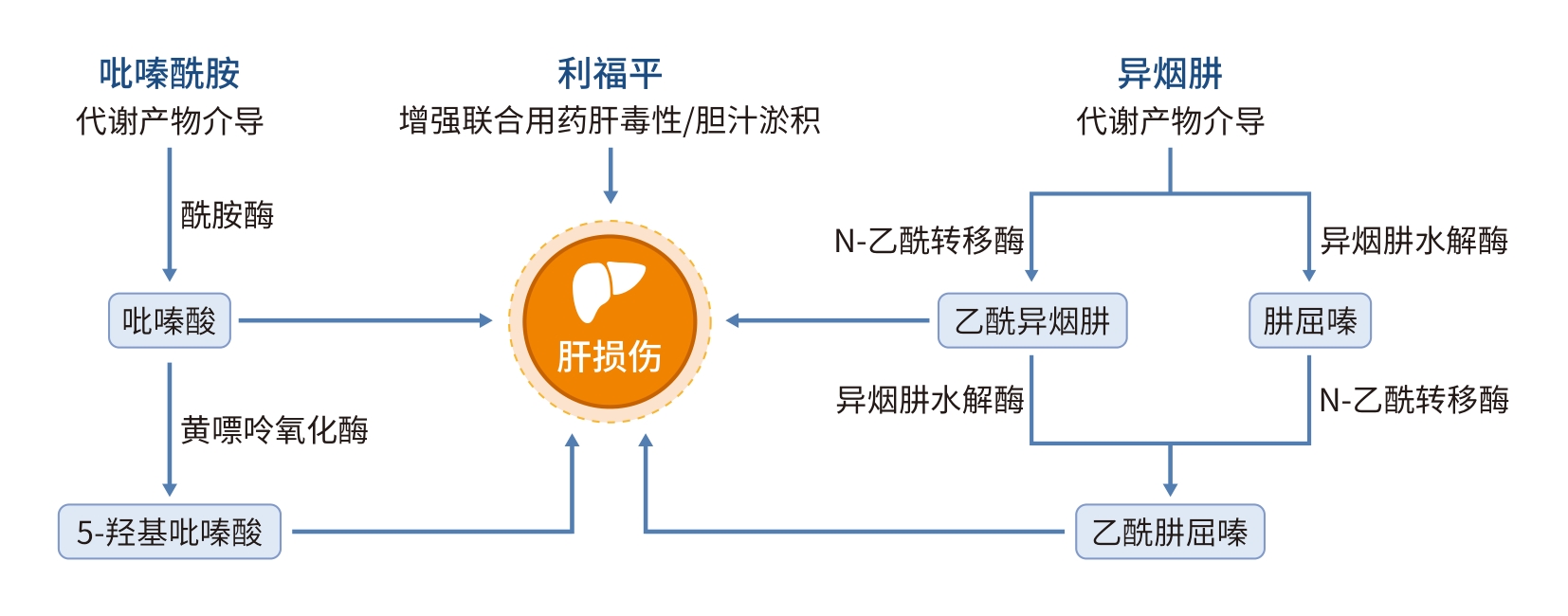
表 1 抗结核药物性肝损伤的临床表型和LiverTox因果关联等级[1-2]
Table 1. Clinical phenotypes of ATB-DILI and the causality grade in LiverTox database[1-2]
抗结核药物及方案 临床表型和特点 所涉联合用药方案 一线抗结核药物 异烟肼/A级 多在治疗开始2个月内发生,以肝细胞型损
伤为主;慢乙酰化型NAT2可增加异烟肼及
毒性代谢物暴露2HRZE/4HR、2HPMZ/2HPM 利福平/A级、利福喷丁/E*级、
利福布汀/D级肝细胞型、胆汁淤积型或混合型损伤,亦可
出现孤立性胆红素升高;药物间相互作用风
险较为突出2HRZE/4HR;2HPMZ/2HPM 吡嗪酰胺/A级 肝毒性与剂量相关,以肝细胞型为主;黄疸
及重症肝损伤的发生风险相对较高2HRZE/4HR、2HPMZ/2HPM 乙胺丁醇/C级 直接肝毒性低,临床显性DILI罕见;少数病
例可能与超敏反应(如DRESS综合征)有关2HRZE/4HR 耐多药结核治疗药物 莫西沙星/B级、左氧氟沙星/A级 肝损伤少见。可呈肝细胞型、胆汁淤积型或
混合型;部分伴发热、皮疹和嗜酸性粒细胞
增多2HPMZ/2HPM、BPaLM,其他耐药抗结核方
案(左氧氟沙星)乙硫异烟胺/B级、丙硫异烟胺/B级 多为肝细胞损伤型 传统耐多药或耐利福平抗结核长程方案 对氨基水杨酸/B级 可致超敏性肝炎 传统耐多药或耐利福平抗结核长程方案 贝达喹啉/E*级、普瑞马尼/D级、
德拉马尼/E*级多表现为一过性氨基转移酶轻度升高,严重
DILI少见;联合方案中单药致病性较难确认BPaL、BPaLM,含德拉马尼的个体化耐药抗
结核方案利奈唑胺/A级 严重DILI少见;损伤线粒体,导致乳酸性酸
中毒,可伴肝功能异常BPaL、BPaLM 肝毒性较低的药物 环丝氨酸/E*级、氯法齐明/E*级、
阿米卡星/E级、链霉素/E级临床显性肝损伤罕见,可有轻度肝酶异常 传统或个体化耐药抗结核方案 注:抗结核药物及方案中药名“/”后的字母表示LiverTox数据库(
https://www.ncbi.nlm.nih.gov/books/NBK547852/ )因果关联评级,A指明确可致临床明显肝损伤,文献报道≥50例;B指很可能导致临床明显肝损伤,文献报道12~49例;C指较可能导致临床明显肝损伤,文献报道<12例;D指可能但罕见导致临床明显肝损伤,文献报道<3例;E指基本不可能引起DILI,有文献报道但缺乏可信度;E*指未经证实但怀疑可致DILI,向监管机构提交的试验数据等非文献资料提示可能致肝损伤。在联合用药方案中,H指异烟肼;R指利福平;Z指吡嗪酰胺;E指乙胺丁醇;P指利福喷丁;M指莫西沙星;BPaL指贝达喹啉、普瑞马尼和利奈唑胺方案;BPaLM指在BPaL基础上加用莫西沙星。NAT2,N-乙酰转移酶2;DILI,药物性肝损伤;DRESS,伴嗜酸性粒细胞增多和系统症状的药物反应。 下载: 导出CSV
-
[1] Lim W S, Avery A, Kon O M, et al. Anti-tuberculosis drug-induced liver injury[J]. BMJ, 2023, 383: e074866. DOI: 10.1136/bmj-2023-074866. [2] Lewis J H, Korkmaz S Y, Rizk C A, et al. Diagnosis, prevention and risk-management of drug-induced liver injury due to medications used to treat Mycobacterium tuberculosis[J]. Expert Opin Drug Saf, 2024, 23( 9): 1093- 1107. DOI: 10.1080/14740338.2024.2399074. [3] Chinese Medical Association Tuberculosis Branch. Guidelines for diagnosis and management of drug-induced liver injury caused by anti-tuberculosis drugs(2024 version)[J]. Chin J Tuberc Respir Dis, 2024, 47( 11): 1069- 1090. DOI: 10.3760/cma.j.cn112147-20240614-00338.中华医学会结核病学分会. 抗结核药所致药物性肝损伤诊治指南(2024年版)[J]. 中华结核和呼吸杂志, 2024, 47( 11): 1069- 1090. DOI: 10.3760/cma.j.cn112147-20240614-00338. [4] Jiang F R, Yan H D, Liang L L, et al. Incidence and risk factors of anti-tuberculosis drug induced liver injury(DILI): Large cohort study involving 4652 Chinese adult tuberculosis patients[J]. Liver Int, 2021, 41( 7): 1565- 1575. DOI: 10.1111/liv.14896. [5] Nyangwara V, Waja Z, Thelingwani R, et al. Incidence and associated risk factors of anti-tuberculosis drug induced liver injury among TB patients[J]. BMC Infect Dis, 2025, 25( 1): 1400. DOI: 10.1186/s12879-025-11796-4. [6] Zhou Y Q, Wang M, Xu H M, et al. Incidence and risk factors of abnormal liver function and anti-tuberculosis drug-induced liver injury: A multicenter retrospective study involving 482 Chinese pediatric tuberculosis patients[J]. Ann Med, 2025, 57( 1): 2546701. DOI: 10.1080/07853890.2025.2546701. [7] Kumar R, Kumar A, Kumar S. Acute liver failure from anti-tuberculosis drug-induced liver injury: An update[J]. World J Hepatol, 2025, 17( 5): 106618. DOI: 10.4254/wjh.v17.i5.106618. [8] Tavkar V, Goyal A, Chopra V, et al. The role of NAT2 genetic variants in anti-tuberculosis drug-induced liver injury(AT-DILI): A meta-analysis[J]. Pharmacogenomics, 2025, 26( 17-18): 787- 803. DOI: 10.1080/14622416.2026.2624364. [9] Huang X, Jiang J, He L, et al. NAT2 rs1495741 and anti-tuberculosis drug-induced liver injury in children: Genetic association and risk prediction[J]. Front Pharmacol, 2026, 17: 1810732. DOI: 10.3389/fphar.2026.1810732. [10] Meitei H N, Pandey A, Haobam R. Polymorphisms in drug metabolism genes as a risk factor for first-line anti-tuberculosis drug-induced liver injury[J]. Mol Biol Rep, 2023, 50( 3): 2893- 2900. DOI: 10.1007/s11033-022-08158-7. [11] Mahajan R, Tyagi A K. Pharmacogenomic insights into tuberculosis treatment shows the NAT2 genetic variants linked to hepatotoxicity risk: A systematic review and meta-analysis[J]. BMC Genom Data, 2024, 25( 1): 103. DOI: 10.1186/s12863-024-01286-y. [12] Xu Y, Jiang Y F, Li Y. Pyrazinamide enhances lipid peroxidation and antioxidant levels to induce liver injury in rat models through PI3k/Akt inhibition[J]. Toxicol Res, 2020, 9( 3): 149- 157. DOI: 10.1093/toxres/tfaa015. [13] Hussain Z, Zhu J J, Ma X C. Metabolism and hepatotoxicity of pyrazinamide, an antituberculosis drug[J]. Drug Metab Dispos, 2021, 49( 8): 679- 682. DOI: 10.1124/dmd.121.000389. [14] Wang Y C, Chen K H, Chen Y L, et al. Pyrazinamide related prolonged drug-induced liver injury: A case report[J]. Medicine, 2022, 101( 39): e30955. DOI: 10.1097/md.0000000000030955. [15] Nyang’wa B T, Berry C, Kazounis E, et al. A 24-week, all-oral regimen for rifampin-resistant tuberculosis[J]. N Engl J Med, 2022, 387( 25): 2331- 2343. DOI: 10.1056/NEJMoa2117166. [16] Dorman S E, Nahid P, Kurbatova E V, et al. Four-month rifapentine regimens with or without moxifloxacin for tuberculosis[J]. N Engl J Med, 2021, 384( 18): 1705- 1718. DOI: 10.1056/NEJMoa2033400. [17] World Health Organization. WHO consolidated guidelines on tuberculosis. Module 4: Treatment-drug-susceptible tuberculosis treatment[R]. Geneva: World Health Organization, 2022. [18] Conradie F, Bagdasaryan T R, Borisov S, et al. Bedaquiline-pretomanid-linezolid regimens for drug-resistant tuberculosis[J]. N Engl J Med, 2022, 387( 9): 810- 823. DOI: 10.1056/NEJMoa2119430. [19] Fontana R J, Liou I, Reuben A, et al. AASLD practice guidance on drug, herbal, and dietary supplement-induced liver injury[J]. Hepatology, 2023, 77( 3): 1036- 1065. DOI: 10.1002/hep.32689. [20] Chalasani N P, Maddur H, Russo M W, et al. ACG clinical guideline: Diagnosis and management of idiosyncratic drug-induced liver injury[J]. Am J Gastroenterol, 2021, 116( 5): 878- 898. DOI: 10.14309/ajg.0000000000001259. [21] Drug-induced Liver Disease Study Group, Chinese Society of Hepatology, Chinese Medical Association. Guidelines for the management of drug-induced liver injury[J]. J Clin Hepatol, 2015, 31( 11): 1752- 1769. DOI: 10.3969/j.issn.1001-5256.2015.11.002.中华医学会肝病学分会药物性肝病学组. 药物性肝损伤诊治指南[J]. 临床肝胆病杂志, 2015, 31( 11): 1752- 1769. DOI: 10.3969/j.issn.1001-5256.2015.11.002. [22] Mao Y M, Ma S W, Liu C H, et al. Chinese guideline for the diagnosis and treatment of drug-induced liver injury: An update[J]. Hepatol Int, 2024, 18( 2): 384- 419. DOI: 10.1007/s12072-023-10633-7. [23] Wang M G, Zhang M M, Liu Q X, et al. Plasma proteomics biomarkers for predicting anti-tuberculosis drug-induced liver injury: A comprehensive assessment[J]. Br J Clin Pharmacol, 2026, 92( 6): 1716- 1729. DOI: 10.1002/bcp.70446. [24] Donovan J, Hung T T, Hiep N T T, et al. A randomised comparison of management strategies for drug-induced liver injury associated with tuberculous meningitis treatment[J]. J Infect, 2026, 93( 2): 106796. DOI: 10.1016/j.jinf.2026.106796. -

 本文二维码
图(1) / 表(1)
计量
- 文章访问数: 18
- HTML全文浏览量: 5
- PDF下载量: 4
- 被引次数: 0


