

 PDF下载 ( 2280 KB)

肝移植免疫排斥与耐受:从传统免疫抑制到间充质干细胞治疗
DOI: 10.12449/JCH260933
Immune rejection and tolerance in liver transplantation: From traditional immunosuppression to mesenchymal stem cell therapy
-
摘要: 肝移植术后免疫排斥反应是影响移植物长期存活的关键制约因素。传统以钙调磷酸酶抑制剂为基石的免疫抑制方案虽有效但伴随长期副作用,促使诱导免疫耐受成为重要目标。本文系统综述了肝移植术后免疫排斥机制及现有药物的局限性,并重点探讨间充质干细胞(MSC)作为新型免疫耐受诱导策略的潜力。初步临床试验证实MSC输注安全性良好,并呈现免疫调节效应,但仍面临输注时机、细胞来源、剂量及与传统方案协同等多重挑战。未来需通过大规模临床试验进一步验证其长期疗效与安全性,MSC疗法有望为肝移植免疫管理提供具有前景的新方向。Abstract: Immune rejection following liver transplantation is a critical factor affecting long-term graft survival. While traditional immunosuppressive regimens based on calcineurin inhibitors are effective, they are often accompanied by long-term side effects, making the induction of immune tolerance an important goal. This article systematically reviews the mechanisms of immune rejection following liver transplantation and the limitations of current drugs, with a focus on the potential of mesenchymal stem cells (MSCs) as a novel strategy for inducing immune tolerance. Preliminary clinical trials have confirmed that MSC infusion has a favorable safety profile and shows an immunomodulatory effect; however, there are still multiple challenges regarding the timing of infusion, cell source, dosage, and synergy with conventional regimens. Large-scale clinical trials are needed in the future to further validate their long-term efficacy and safety, and MSC therapy is expected to become a new direction for immune management in liver transplantation.
-
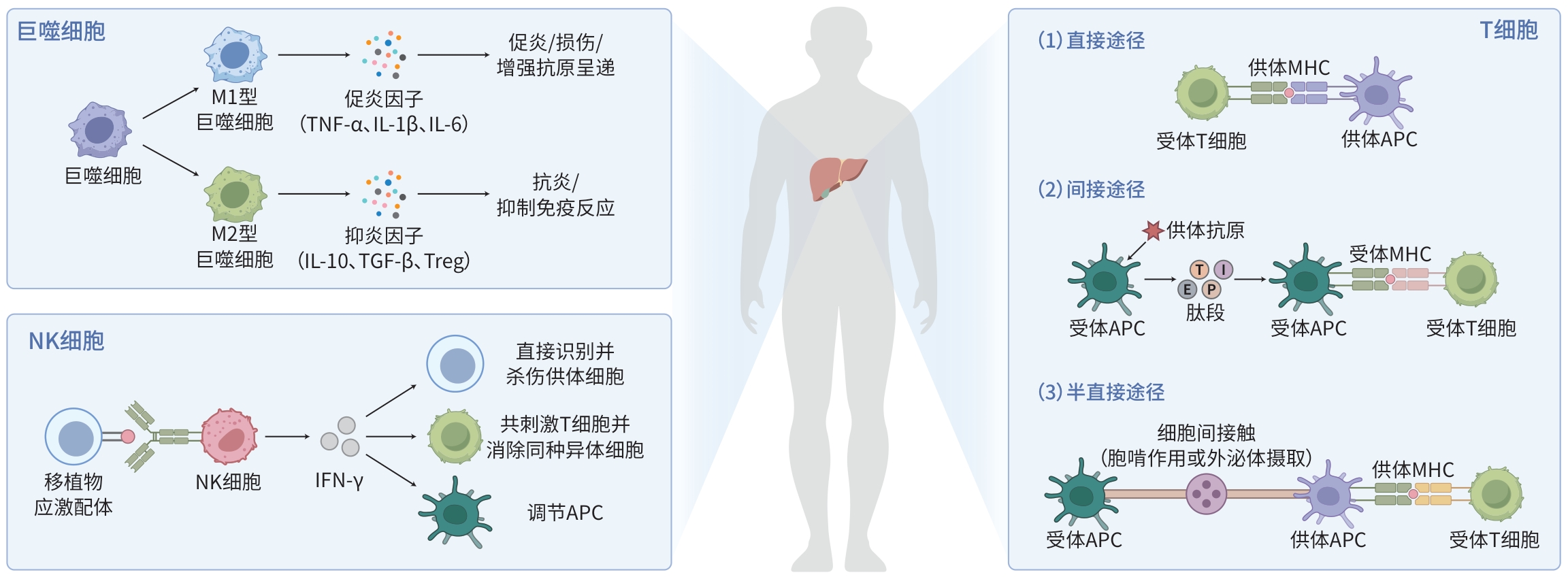
注: TNF-α,肿瘤坏死因子α;IL,白细胞介素;TGF-β,转化生长因子β;Treg,调节性T细胞;NK细胞,自然杀伤细胞;IFN-γ,干扰素γ;APC,抗原呈递细胞;MHC,主要组织相容性复合物。
图 1 肝移植免疫排斥机制
Figure 1. Mechanisms of immune rejection in liver transplantation
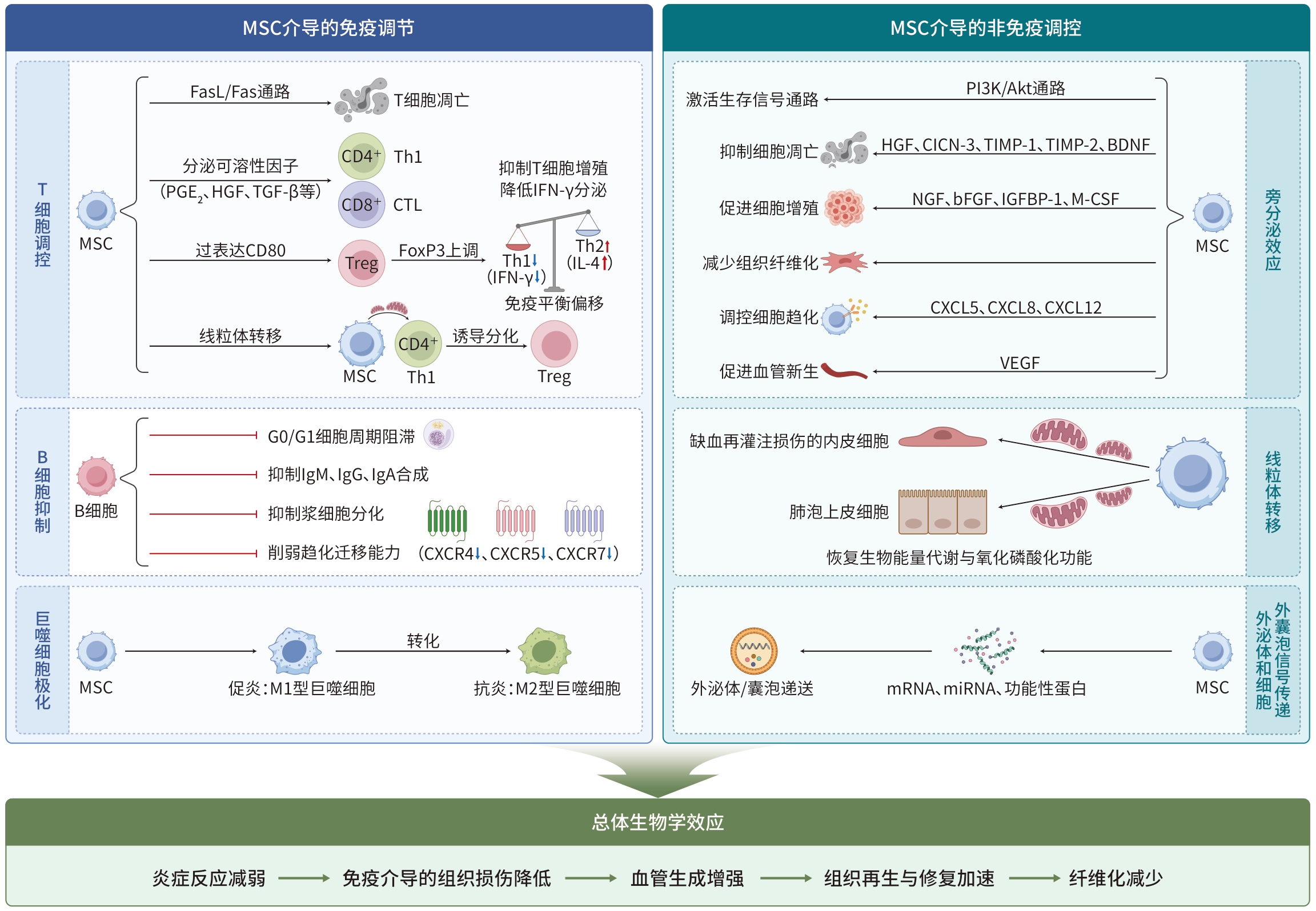
注: MSC,间充质干细胞;PGE2,前列腺素E2;HGF,肝细胞生长因子;TGF-β,转化生长因子β;Treg,调节性T细胞;VEGF,血管内皮生长因子;IFN-γ,干扰素γ;bFGF,碱性成纤维细胞生长因子;TIMP,金属蛋白酶组织抑制剂;BDNF,脑源性神经营养因子;NGF,神经生长因子;IGFBP-1,胰岛素样生长因子结合蛋白1;M-CSF,巨噬细胞集落刺激因子;FoxP3,叉头框蛋白P3;Th,辅助性T细胞;IL,白细胞介素;IgM/G/A,免疫球蛋白M/G/A;PI3K,磷脂酰肌醇3-激酶;Akt,蛋白激酶B;CXCL,CXC亚族趋化因子配体;CXCR,CXC亚族趋化因子受体;CTL,细胞毒性T淋巴细胞;CICN-3,氯离子通道蛋白3。
图 2 MSC的免疫调节与组织修复功能
Figure 2. Immunomodulatory and tissue repair functions of MSC
表 1 肝移植常用免疫抑制剂对比
Table 1. Comparison of commonly used immunosuppressants in liver transplantation
免疫抑制方案 药物 作用机制 不良事件 临床应用 CNI CsA 通过结合细胞内亲环素抑制T细胞活化及钙
调磷酸酶活性,阻碍活化T细胞核因子去磷
酸化及IL-2转录,从而抑制排斥反应肾毒性、神经毒性、震颤、
代谢紊乱、牙龈过度生长、
多毛症第一代CNI,已被TAC取代 TAC 通过结合FKBP12抑制钙调神经磷酸酶 肾毒性、神经毒性、代谢紊
乱(糖尿病、血脂异常)、心
血管并发症(高血压、心律
失常)、罕见病毒感染等免疫抑制的基石,药效是CsA
的100倍,单药TAC是稳定受
者长期维持治疗的首选mTOR抑制剂 SRL、 PI3K/Akt/mTOR通路调控细胞生长、代谢、自
噬及血管生成,在HCC中,mTOR通路常被异
常激活,与肿瘤进展、复发和预后不良相关。
mTOR抑制剂通过与FKBP12结合,抑制
mTOR丝氨酸苏氨酸激酶活性,从而减少蛋白
质合成和细胞增殖口腔炎、皮疹、感染、肺毒
性、代谢并发症、贫血、血
小板减少协同CNI以减轻其暴露,优化
受者肾功能,避免或减少其
他不良事件发生,并潜在降
低HCV与HCC复发以及肝移
植术后新发恶性肿瘤风险EVR 抗增殖剂 MPA 可逆性地抑制次黄嘌呤单核苷酸脱氢酶,该
酶是鸟嘌呤核苷酸经典合成途径中的限速
酶。T细胞和B细胞高度依赖此途径增殖,且
无法通过补救途径合成,故MPA能相对选择
性地抑制淋巴细胞增殖;此外,MPA被证明可
以增加T细胞,尤其是活化T细胞的凋亡胃肠道紊乱(腹泻和结肠
炎)、贫血、白细胞或血小
板减少、感染、新发恶性肿
瘤等通常使用12个月后停用,以
减少长期副作用(如胃肠道
反应、骨髓抑制)皮质类固醇 GC 抑制树突状细胞上调共刺激分子(CD40、
CD80、CD83、CD86)及MHC-Ⅱ类分子,从而
削弱其启动T细胞的能力;诱导单核细胞向
抗炎表型转化(IL-10↑、IL-1β及IL-12↓);抑
制中性粒细胞的NADPH氧化酶、诱导型一氧
化氮合酶和环氧合酶-2活性,削弱其趋化、吞
噬及细胞因子分泌功能;通过长期低浓度GC
减少穿孔素和颗粒酶B的组蛋白启动子乙酰
化(如H3K9Ac、H3K27Ac、H4K8Ac)降低NK
细胞活性;通过减少IL-1、IL-2及IL-3等细胞
因子的产生,抑制T细胞活化库欣样症状、精神症状、骨质疏松症、糖尿病、心血管疾病、肥胖等 CNI、GC与MMF的三联药物
方案是最常见的诱导方案
(肝移植术后30 d内为诱导
期);合并自身免疫性肝病或
曾患TCMR需长期低剂量GC
维持治疗注:CsA,环孢素;TAC,他克莫司;SRL,西罗莫司;EVR,依维莫司;MPA,麦考酚酸;GC,糖皮质激素;mTOR,哺乳动物雷帕霉素靶蛋白;CNI,钙调磷酸酶抑制剂;HCC,肝细胞癌;HCV,丙型肝炎病毒;IL,白细胞介素;TCMR,T细胞介导排斥反应;NK细胞,自然杀伤细胞;PI3K,磷脂酰肌醇3-激酶;Akt,蛋白激酶B;NADPH,还原型烟酰胺腺嘌呤二核苷酸磷酸;MMF,麦考酚酯;MHC,主要组织相容性复合物。
 下载: 导出CSV
-
[1] Stolp J, Zaitsu M, Wood K J. Immune tolerance and rejection in organ transplantation[J]. Methods Mol Biol, 2019, 1899: 159- 180. DOI: 10.1007/978-1-4939-8938-6_12. [2] Fahrner R, Dondorf F, Ardelt M, et al. Role of NK, NKT cells and macrophages in liver transplantation[J]. World J Gastroenterol, 2016, 22( 27): 6135- 6144. DOI: 10.3748/wjg.v22.i27.6135. [3] Angelico R, Sensi B, Manzia T M, et al. Chronic rejection after liver transplantation: Opening the Pandora’s box[J]. World J Gastroenterol, 2021, 27( 45): 7771- 7783. DOI: 10.3748/wjg.v27.i45.7771. [4] Ronca V, Wootton G, Milani C, et al. The immunological basis of liver allograft rejection[J]. Front Immunol, 2020, 11: 2155. DOI: 10.3389/fimmu.2020.02155. [5] Duneton C, Winterberg P D, Ford M L. Activation and regulation of alloreactive T cell immunity in solid organ transplantation[J]. Nat Rev Nephrol, 2022, 18( 10): 663- 676. DOI: 10.1038/s41581-022-00600-0. [6] Kovandova B, Slavcev A, Honsova E, et al. De novo HLA Class II antibodies are associated with the development of chronic but not acute antibody-mediated rejection after liver transplantation- a retrospective study[J]. Transpl Int, 2020, 33( 12): 1799- 1806. DOI: 10.1111/tri.13763. [7] Pan Q, Zhou A W, Wang B R, et al. Diagnostic and predictive biomarkers of acute rejection after liver transplantation[J]. Int J Surg, 2025, 111( 6): 3908- 3919. DOI: 10.1097/JS9.0000000000002358. [8] Cicalese L, Walton Z C, Du X T, et al. Antibody-mediated rejection in liver transplantation: Immuno-pathological characteristics and long-term follow-up[J]. Transpl Int, 2024, 37: 13232. DOI: 10.3389/ti.2024.13232. [9] Höfer A, Jonigk D, Hartleben B, et al. Non-invasive screening for subclinical liver graft injury in adults via donor-specific anti-HLA antibodies[J]. Sci Rep, 2020, 10( 1): 14242. DOI: 10.1038/s41598-020-70938-7. [10] Sica A, Invernizzi P, Mantovani A. Macrophage plasticity and polarization in liver homeostasis and pathology[J]. Hepatology, 2014, 59( 5): 2034- 2042. DOI: 10.1002/hep.26754. [11] Cao Z R, Zheng W X, Jiang Y X, et al. miR-449a ameliorates acute rejection after liver transplantation via targeting procollagen-lysine1, 2-oxoglutarate5-dioxygenase 1 in macrophages[J]. Am J Transplant, 2023, 23( 3): 336- 352. DOI: 10.1016/j.ajt.2022.12.009. [12] Huang W F, Jiang L Q, Jiang Y S, et al. ANGPTL4 induces Kupffer cell M2 polarization to mitigate acute rejection in liver transplantation[J]. Sci Rep, 2025, 15: 986. DOI: 10.1038/s41598-024-81832-x. [13] Xu X S, Feng Z H, Cao D, et al. SCARF1 promotes M2 polarization of Kupffer cells via calcium-dependent PI3K-AKT-STAT3 signalling to improve liver transplantation[J]. Cell Prolif, 2021, 54( 4): e13022. DOI: 10.1111/cpr.13022. [14] Obara H, Nagasaki K, Hsieh C L, et al. IFN-gamma, produced by NK cells that infiltrate liver allografts early after transplantation, links the innate and adaptive immune responses[J]. Am J Transplant, 2005, 5( 9): 2094- 2103. DOI: 10.1111/j.1600-6143.2005.00995.x. [15] Chen Bing, Zuo Xiaocong, Li Xingang, et al. Expert consensus on the model informed precision dosing of tacrolimus in patients receiving anti-rejection therapy[J]. Chin J Clin Pharmacol Ther, 2025, 30( 4): 433- 445. DOI: 10.12092/j.issn.1009-2501.2025.04.001.陈冰, 左笑丛, 李新刚, 等. 模型引导的抗排异治疗患者他克莫司精准用药专家共识[J]. 中国临床药理学与治疗学, 2025, 30( 4): 433- 445. DOI: 10.12092/j.issn.1009-2501.2025.04.001. [16] European FK 506 Multicentre Liver Study Group. Randomised trial comparing tacrolimus(FK506) and cyclosporin in prevention of liver allograft rejection[J]. Lancet, 1994, 344( 8920): 423- 428. DOI: 10.1016/S0140-6736(94)91766-3. [17] Reich D J, Clavien P A, Hodge E E, et al. Mycophenolate mofetil for renal dysfunction in liver transplant recipients on cyclosporine or tacrolimus: Randomized, prospective, multicenter pilot study results[J]. Transplantation, 2005, 80( 1): 18- 25. DOI: 10.1097/01.tp.0000165118.00988.d7. [18] Boudjema K, Camus C, Saliba F, et al. Reduced-dose tacrolimus with mycophenolate mofetil vs. Standard-dose tacrolimus in liver transplantation: A randomized study[J]. Am J Transplant, 2011, 11( 5): 965- 976. DOI: 10.1111/j.1600-6143.2011.03486.x. [19] Sanford M, Keating G M. Enteric-coated mycophenolate sodium: A review of its use in the prevention of renal transplant rejection[J]. Drugs, 2008, 68( 17): 2505- 2533. DOI: 10.2165/0003495-200868170-00007. [20] Granata S, Dalla Gassa A, Carraro A, et al. Sirolimus and everolimus pathway: Reviewing candidate genes influencing their intracellular effects[J]. Int J Mol Sci, 2016, 17( 5): 735. DOI: 10.3390/ijms17050735. [21] Buchholz B M, Ferguson J W, Schnitzbauer A A, et al. Randomized sirolimus-based early calcineurin inhibitor reduction in liver transplantation: Impact on renal function[J]. Transplantation, 2020, 104( 5): 1003- 1018. DOI: 10.1097/TP.0000000000002980. [22] Saliba F, Fischer L, de Simone P, et al. Association between renal dysfunction and major adverse cardiac events after liver transplantation: Evidence from an international randomized trial of everolimus-based immunosuppression[J]. Ann Transplant, 2018, 23: 751- 757. DOI: 10.12659/AOT.911030. [23] Wadei H M, Zaky Z S, Keaveny A P, et al. Proteinuria following sirolimus conversion is associated with deterioration of kidney function in liver transplant recipients[J]. Transplantation, 2012, 93( 10): 1006- 1012. DOI: 10.1097/TP.0b013e31824bbd01. [24] Toso C, Merani S, Bigam D L, et al. Sirolimus-based immunosuppression is associated with increased survival after liver transplantation for hepatocellular carcinoma[J]. Hepatology, 2010, 51( 4): 1237- 1243. DOI: 10.1002/hep.23437. [25] Zhang L C, Liu P, Zhuang L, et al. mTOR inhibitor reduces nontumour-related death in liver transplantation for hepatocellular carcinoma[J]. Mol Biomed, 2024, 5( 1): 9. DOI: 10.1186/s43556-024-00170-6. [26] Fairfield C, Penninga L, Powell J, et al. Glucocorticosteroid-free versus glucocorticosteroid-containing immunosuppression for liver transplanted patients[J]. Cochrane Database Syst Rev, 2015,(12): CD 007606. DOI: 10.1002/14651858.CD007606.pub3. [27] Moench C, Barreiros A P, Schuchmann M, et al. Tacrolimus monotherapy without steroids after liver transplantation—a prospective randomized double-blinded placebo-controlled trial[J]. Am J Transplant, 2007, 7( 6): 1616- 1623. DOI: 10.1111/j.1600-6143.2007.01804.x. [28] Lerut J P, Pinheiro R S, Lai Q, et al. Is minimal,[almost] steroid-free immunosuppression a safe approach in adult liver transplantation? Long-term outcome of a prospective, double blind, placebo-controlled, randomized, investigator-driven study[J]. Ann Surg, 2014, 260( 5): 886- 892. DOI: 10.1097/SLA.0000000000000969. [29] Cotton J L, Suarez-Pierre A, Breithaupt J J, et al. Survival following liver transplantation: A population-based nested case-control study[J]. Am J Surg, 2024, 228: 264- 272. DOI: 10.1016/j.amjsurg.2023.10.039. [30] Åberg F, Gissler M, Karlsen T H, et al. Differences in long-term survival among liver transplant recipients and the general population: A population-based Nordic study[J]. Hepatology, 2015, 61( 2): 668- 677. DOI: 10.1002/hep.27538. [31] Zhou A W, Jin J, Liu Y. Cellular strategies to induce immune tolerance after liver transplantation: Clinical perspectives[J]. World J Gastroenterol, 2024, 30( 13): 1791- 1800. DOI: 10.3748/wjg.v30.i13.1791. [32] Song N, Scholtemeijer M, Shah K. Mesenchymal stem cell immunomodulation: Mechanisms and therapeutic potential[J]. Trends Pharmacol Sci, 2020, 41( 9): 653- 664. DOI: 10.1016/j.tips.2020.06.009. [33] Spees J L, Lee R H, Gregory C A. Mechanisms of mesenchymal stem/stromal cell function[J]. Stem Cell Res Ther, 2016, 7( 1): 125. DOI: 10.1186/s13287-016-0363-7. [34] Liu K M, Ji K Q, Guo L, et al. Mesenchymal stem cells rescue injured endothelial cells in an in vitro ischemia-reperfusion model via tunneling nanotube like structure-mediated mitochondrial transfer[J]. Microvasc Res, 2014, 92: 10- 18. DOI: 10.1016/j.mvr.2014.01.008. [35] Zhang L, Ouyang P R, He G L, et al. Exosomes from microRNA-126 overexpressing mesenchymal stem cells promote angiogenesis by targeting the PIK3R2-mediated PI3K/Akt signalling pathway[J]. J Cell Mol Med, 2021, 25( 4): 2148- 2162. DOI: 10.1111/jcmm.16192. [36] Gong Y H, You Q, Yuan X F, et al. Mesenchymal stem cell-derived extracellular vesicles attenuate ferroptosis in aged hepatic ischemia/reperfusion injury by transferring miR-1275[J]. Redox Biol, 2025, 81: 103556. DOI: 10.1016/j.redox.2025.103556. [37] Paganelli A, Trubiani O, Diomede F, et al. Immunomodulating profile of dental mesenchymal stromal cells: A comprehensive overview[J]. Front Oral Health, 2021, 2: 635055. DOI: 10.3389/froh.2021.635055. [38] Mittal S K, Cho W, Elbasiony E, et al. Mesenchymal stem cells augment regulatory T cell function via CD80-mediated interactions and promote allograft survival[J]. Am J Transplant, 2022, 22( 6): 1564- 1577. DOI: 10.1111/ajt.17001. [39] Court A C, Le-Gatt A, Luz-Crawford P, et al. Mitochondrial transfer from MSCs to T cells induces Treg differentiation and restricts inflammatory response[J]. EMBO Rep, 2020, 21( 2): e48052. DOI: 10.15252/embr.201948052. [40] Corcione A, Benvenuto F, Ferretti E, et al. Human mesenchymal stem cells modulate B-cell functions[J]. Blood, 2006, 107( 1): 367- 372. DOI: 10.1182/blood-2005-07-2657. [41] Cho D I, Kim M R, Jeong H Y, et al. Mesenchymal stem cells reciprocally regulate the M1/M2 balance in mouse bone marrow-derived macrophages[J]. Exp Mol Med, 2014, 46( 1): e70. DOI: 10.1038/emm.2013.135. [42] Li S W, Cai Y, Mao X L, et al. The immunomodulatory properties of mesenchymal stem cells play a critical role in inducing immune tolerance after liver transplantation[J]. Stem Cells Int, 2021, 2021( 1): 6930263. DOI: 10.1155/2021/6930263. [43] Wu L L, Cao H, Tian X, et al. Bone marrow mesenchymal stem cells modified with heme oxygenase-1 alleviate rejection of donation after circulatory death liver transplantation by inhibiting dendritic cell maturation in rats[J]. Int Immunopharmacol, 2022, 107: 108643. DOI: 10.1016/j.intimp.2022.108643. [44] Shao Chenliang, Pang Li, Liu Chao, et al. Clinical research progress on cell therapy induced immune tolerance in liver transplantation[J]. Organ Transplant, 2026, 17( 2): 205- 211. DOI: 10.12464/j.issn.1674-7445.2025248.邵晨亮, 庞立, 刘超, 等. 细胞治疗诱导肝移植免疫耐受临床研究进展[J]. 器官移植, 2026, 17( 2): 205- 211. DOI: 10.12464/j.issn.1674-7445.2025248. [45] Sasajima H, Miyagi S, Yamada S, et al. Cytoprotective effects of mesenchymal stem cells during liver transplantation from donors after cardiac death in swine[J]. Transplant Proc, 2020, 52( 6): 1891- 1900. DOI: 10.1016/j.transproceed.2020.01.165. [46] Gao W, Zhang L Z, Zhang Y Y, et al. Adipose-derived mesenchymal stem cells promote liver regeneration and suppress rejection in small-for-size liver allograft[J]. Transpl Immunol, 2017, 45: 1- 7. DOI: 10.1016/j.trim.2017.07.005. [47] Davis T A, Anam K, Lazdun Y, et al. Adipose-derived stromal cells promote allograft tolerance induction[J]. Stem Cells Transl Med, 2014, 3( 12): 1444- 1450. DOI: 10.5966/sctm.2014-0131. [48] Chambers D C, Enever D, Lawrence S, et al. Mesenchymal stromal cell therapy for chronic lung allograft dysfunction: Results of a first-in-man study[J]. Stem Cells Transl Med, 2017, 6( 4): 1152- 1157. DOI: 10.1002/sctm.16-0372. [49] Keller C A, Gonwa T A, Hodge D O, et al. Feasibility, safety, and tolerance of mesenchymal stem cell therapy for obstructive chronic lung allograft dysfunction[J]. Stem Cells Transl Med, 2018, 7( 2): 161- 167. DOI: 10.1002/sctm.17-0198. [50] Reinders M E, de Fijter J W, Roelofs H, et al. Autologous bone marrow-derived mesenchymal stromal cells for the treatment of allograft rejection after renal transplantation: Results of a phase I study[J]. Stem Cells Transl Med, 2013, 2( 2): 107- 111. DOI: 10.5966/sctm.2012-0114. [51] Reinders M E J, Groeneweg K E, Hendriks S H, et al. Autologous bone marrow-derived mesenchymal stromal cell therapy with early tacrolimus withdrawal: The randomized prospective, single-center, open-label TRITON study[J]. Am J Transplant, 2021, 21( 9): 3055- 3065. DOI: 10.1111/ajt.16528. [52] Franquesa M, Hoogduijn M J, Reinders M E, et al. Mesenchymal Stem Cells in Solid Organ Transplantation(MiSOT) Fourth Meeting: Lessons learned from first clinical trials[J]. Transplantation, 2013, 96( 3): 234- 238. DOI: 10.1097/TP.0b013e318298f9fa. [53] Baertschiger R M, Serre-Beinier V, Morel P, et al. Fibrogenic potential of human multipotent mesenchymal stromal cells in injured liver[J]. PLoS One, 2009, 4( 8): e6657. DOI: 10.1371/journal.pone.0006657. [54] Detry O, Vandermeulen M, Delbouille M H, et al. Infusion of mesenchymal stromal cells after deceased liver transplantation: A phase I-II, open-label, clinical study[J]. J Hepatol, 2017, 67( 1): 47- 55. DOI: 10.1016/j.jhep.2017.03.001. [55] Shi M, Liu Z W, Wang Y, et al. A pilot study of mesenchymal stem cell therapy for acute liver allograft rejection[J]. Stem Cells Transl Med, 2017, 6( 12): 2053- 2061. DOI: 10.1002/sctm.17-0134. [56] Hartleif S, Schumm M, Döring M, et al. Safety and tolerance of donor-derived mesenchymal stem cells in pediatric living-donor liver transplantation: The MYSTEP1 study[J]. Stem Cells Int, 2017, 2017( 1): 2352954. DOI: 10.1155/2017/2352954. [57] Zhang Y C, Liu W, Fu B S, et al. Therapeutic potentials of umbilical cord-derived mesenchymal stromal cells for ischemic-type biliary lesions following liver transplantation[J]. Cytotherapy, 2017, 19( 2): 194- 199. DOI: 10.1016/j.jcyt.2016.11.005. -

 本文二维码
计量
- 文章访问数: 12
- HTML全文浏览量: 7
- PDF下载量: 1
- 被引次数: 0


