

 PDF下载 ( 1328 KB)

肝细胞癌脂肪酸代谢重编程的免疫调控效应及靶向治疗策略
DOI: 10.12449/JCH260931
利益冲突声明:本文不存在任何利益冲突。
作者贡献声明:高沿航和季慧范负责课题设计;郭绍华和贾成政负责查阅文献并起草论文;高沿航、季慧范、贾成政、于睿莹、刘晨旭和李想参与文章撰写及修改,校阅论文。郭绍华和贾成政对本文贡献等同,为共同第一作者。
Immunoregulatory effect of fatty acid metabolic reprogramming in hepatocellular carcinoma and targeted therapeutic strategies
-
摘要: 代谢重编程是肝细胞癌的关键特征,其中脂肪酸代谢异常与肿瘤免疫逃逸密切相关。本文系统介绍了肝细胞癌中脂肪酸代谢重编程的分子机制,重点阐述了从头脂肪合成和脂肪酸氧化通路的关键酶及其转录调控网络,分析了β-联蛋白突变型与AXIN1突变型肝细胞癌的代谢异质性及其治疗意义,归纳了脂质微环境调控免疫细胞功能的多维度机制,最后总结了针对不同肝细胞癌分子亚型的靶向治疗策略。Abstract: Metabolic reprogramming is a key characteristic of hepatocellular carcinoma, and abnormal fatty acid metabolism is closely associated with tumor immune escape. This article systematically reviews the molecular mechanisms of fatty acid metabolic reprogramming in hepatocellular carcinoma, focusing on key enzymes and their transcriptional regulatory networks within de novo lipogenesis and fatty acid oxidation pathways. This article also analyzes the metabolic heterogeneity between β-catenin-mutant hepatocellular carcinoma and AXIN1-mutant hepatocellular carcinoma and their therapeutic implications, summarizes the multidimensional mechanisms by which the lipid microenvironment regulates immune cell function, and reviews the targeted therapeutic strategies for different molecular subtypes of hepatocellular carcinoma.
-
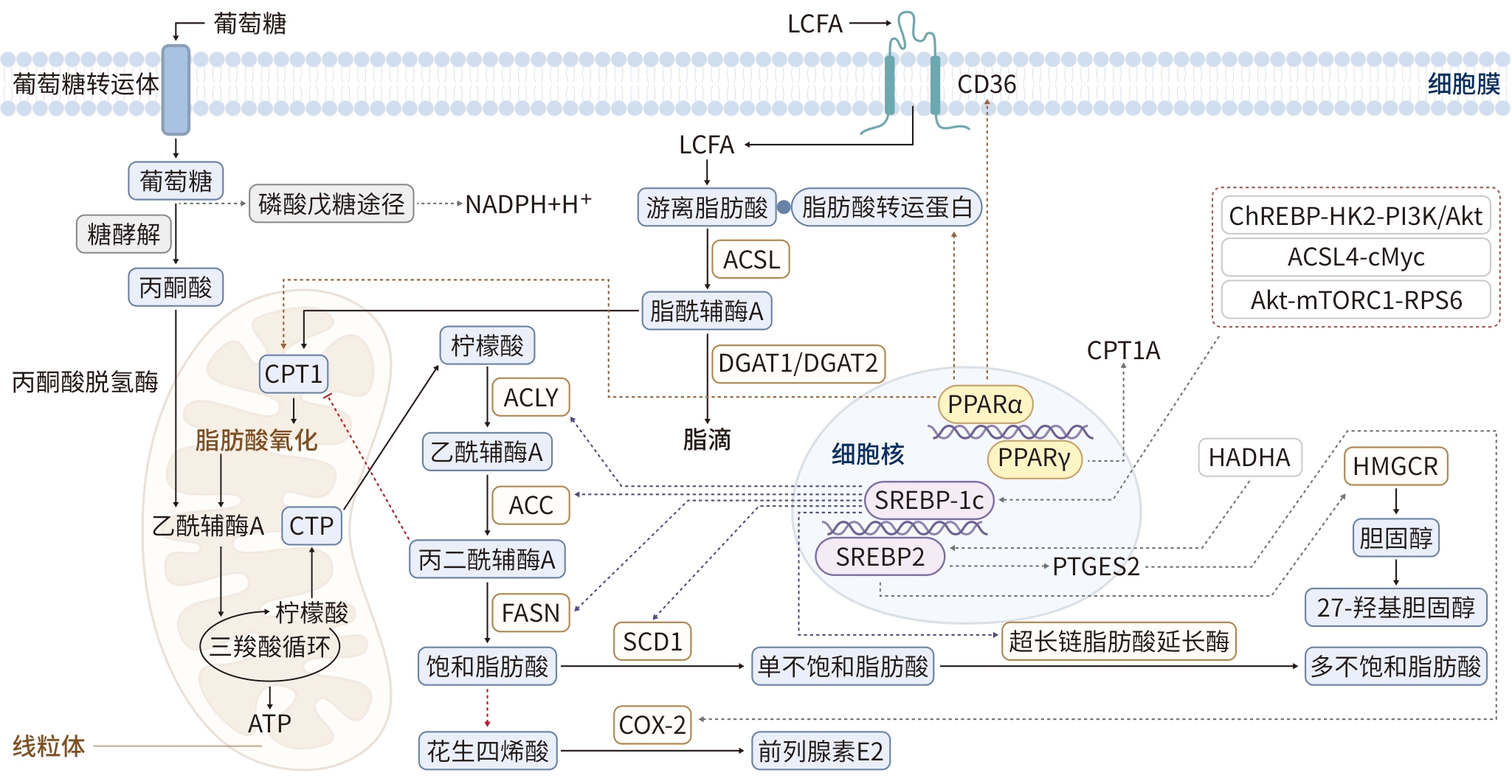
注: LCFA,长链脂肪酸;CD36,分化簇36;ACSL,长链酰基辅酶A合成酶;NADPH,还原型烟酰胺腺嘌呤二核苷酸磷酸;CTP,胞苷-5'-三磷酸;CPT1,肉碱棕榈酰转移酶1;ATP,三磷酸腺苷;ACLY,三磷酸腺苷柠檬酸裂解酶;ACC,乙酰辅酶A羧化酶;FASN,脂肪酸合酶;SCD1,硬脂酰辅酶A去饱和酶1;COX-2,环氧合酶2;DGAT,二酰甘油酰基转移酶;PPAR,过氧化物酶体增殖物激活受体;SREBP,固醇调节元件结合蛋白;PTGES2,前列腺素E合酶2;HADHA,羟烷基辅酶A脱氢酶/3-酮乙基辅酶A硫解酶/烯酰辅酶A水合酶;HMGCR,羟甲基戊二酸单酰辅酶A还原酶;ChREBP,碳水化合物反应元件结合蛋白;HK2,己糖激酶2;PI3K,磷脂酰肌醇3-激酶;Akt,蛋白激酶B;c-Myc,细胞髓细胞瘤基因;mTORC1,哺乳动物雷帕霉素靶蛋白复合物1;RPS6,核糖体蛋白S6。
图 1 肝细胞癌中脂肪酸代谢重编程的关键通路及转录调控网络
Figure 1. Key pathways and transcriptional regulatory networks for fatty acid metabolism reprogramming in hepatocellular carcinoma
-
[1] Bray F, Laversanne M, Sung H, et al. Global cancer statistics 2022: GLOBOCAN estimates of incidence and mortality worldwide for 36 cancers in 185 countries[J]. CA Cancer J Clin, 2024, 74( 3): 229- 263. DOI: 10.3322/caac.21834. [2] Hanahan D. Hallmarks of cancer: New dimensions[J]. Cancer Discov, 2022, 12( 1): 31- 46. DOI: 10.1158/2159-8290.cd-21-1059. [3] An L B, Li Z F. Molecular network of metabolic reprogramming and precision diagnosis and treatment of hepatocellular carcinoma[J]. Biomark Res, 2025, 13( 1): 124. DOI: 10.1186/s40364-025-00844-5. [4] Xia L Z, Oyang L, Lin J G, et al. The cancer metabolic reprogramming and immune response[J]. Mol Cancer, 2021, 20( 1): 28. DOI: 10.1186/s12943-021-01316-8. [5] Senni N, Savall M, Cabrerizo Granados D, et al. β-catenin-activated hepatocellular carcinomas are addicted to fatty acids[J]. Gut, 2019, 68( 2): 322- 334. DOI: 10.1136/gutjnl-2017-315448. [6] Li L, Zhang XJ, Xu G, et al. Transcriptional regulation of de novo lipogenesis by SIX1 in liver cancer cells[J]. Adv Sci, 2024, 11( 41): 2404229. DOI: 10.1002/advs.202404229. [7] Calvisi D F, Wang C M, Ho C, et al. Increased lipogenesis, induced by AKT-mTORC1-RPS6 signaling, promotes development of human hepatocellular carcinoma[J]. Gastroenterology, 2011, 140( 3): 1071- 1083. DOI: 10.1053/j.gastro.2010.12.006. [8] Pérez-Díaz A J, Núñez-Sánchez M Á, Ramos-Molina B. Revisiting liver metabolism through acetyl-CoA carboxylase inhibition[J]. Trends Endocrinol Metab, 2024, 35( 7): 563- 565. DOI: 10.1016/j.tem.2024.04.010. [9] Huang J, Tsang W Y, Fang X N, et al. FASN inhibition decreases MHC-I degradation and synergizes with PD-L1 checkpoint blockade in hepatocellular carcinoma[J]. Cancer Res, 2024, 84( 6): 855- 871. DOI: 10.1158/0008-5472.can-23-0966. [10] Li Y, Yang W J, Zheng Y Y, et al. Targeting fatty acid synthase modulates sensitivity of hepatocellular carcinoma to sorafenib via ferroptosis[J]. J Exp Clin Cancer Res, 2023, 42( 1): 6. DOI: 10.1186/s13046-022-02567-z. [11] Liu H H, Xu Y, Li C J, et al. An SCD1-dependent mechanoresponsive pathway promotes HCC invasion and metastasis through lipid metabolic reprogramming[J]. Mol Ther, 2022, 30( 7): 2554- 2567. DOI: 10.1016/j.ymthe.2022.03.015. [12] Lehrich B M, Monga S P. WNT-β-catenin signalling in hepatocellular carcinoma: From bench to clinical trials[J]. Nat Rev Gastroenterol Hepatol, 2026, 23( 3): 246- 263. DOI: 10.1038/s41575-025-01127-y. [13] Calle R A, Amin N B, Carvajal-Gonzalez S, et al. ACC inhibitor alone or co-administered with a DGAT2 inhibitor in patients with non-alcoholic fatty liver disease: Two parallel, placebo-controlled, randomized phase 2a trials[J]. Nat Med, 2021, 27( 10): 1836- 1848. DOI: 10.1038/s41591-021-01489-1. [14] Benichou E, Seffou B, Topçu S, et al. The transcription factor ChREBP Orchestrates liver carcinogenesis by coordinating the PI3K/AKT signaling and cancer metabolism[J]. Nat Commun, 2024, 15: 1879. DOI: 10.1038/s41467-024-45548-w. [15] Chen J R, Ding C F, Chen Y H, et al. ACSL4 reprograms fatty acid metabolism in hepatocellular carcinoma via c-Myc/SREBP1 pathway[J]. Cancer Lett, 2021, 502: 154- 165. DOI: 10.1016/j.canlet.2020.12.019. [16] Li J B, Huang Q C, Long X Y, et al. CD147 reprograms fatty acid metabolism in hepatocellular carcinoma cells through Akt/mTOR/SREBP1c and P38/PPARα pathways[J]. J Hepatol, 2015, 63( 6): 1378- 1389. DOI: 10.1016/j.jhep.2015.07.039. [17] Ma K, Chu J H, Liu Y F, et al. Hepatocellular carcinoma LINC01116 outcompetes T cells for linoleic acid and accelerates tumor progression[J]. Adv Sci, 2024, 11( 21): 2400676. DOI: 10.1002/advs.202400676. [18] Qin Y F, Huo F, Feng Z, et al. CD36 promotes iron accumulation and dysfunction in CD8+ T cells via the p38-CEBPB-TfR1 axis in early-stage hepatocellular carcinoma[J]. Clin Mol Hepatol, 2025, 31( 3): 960- 980. DOI: 10.3350/cmh.2024.0948. [19] Wabitsch S, Mccallen J D, Kamenyeva O, et al. Metformin treatment rescues CD8+ T-cell response to immune checkpoint inhibitor therapy in mice with NAFLD[J]. J Hepatol, 2022, 77( 3): 748- 760. DOI: 10.1016/j.jhep.2022.03.010. [20] Gu M, Zhang Y, Lin Z J, et al. Decrease in UCP1 by sustained high lipid promotes NK cell necroptosis to exacerbate nonalcoholic liver fibrosis[J]. Cell Death Dis, 2024, 15: 518. DOI: 10.1038/s41419-024-06910-4. [21] Qin W H, Yang Z S, Li M, et al. High serum levels of cholesterol increase antitumor functions of nature killer cells and reduce growth of liver tumors in mice[J]. Gastroenterology, 2020, 158( 6): 1713- 1727. DOI: 10.1053/j.gastro.2020.01.028. [22] Wang Y C, Chen W B, Qiao S, et al. Lipid droplet accumulation mediates macrophage survival and Treg recruitment via the CCL20/CCR6 axis in human hepatocellular carcinoma[J]. Cell Mol Immunol, 2024, 21( 10): 1120- 1130. DOI: 10.1038/s41423-024-01199-x. [23] Huang J J, Pan H Y, Sun J, et al. TMEM147 aggravates the progression of HCC by modulating cholesterol homeostasis, suppressing ferroptosis, and promoting the M2 polarization of tumor-associated macrophages[J]. J Exp Clin Cancer Res, 2023, 42( 1): 286. DOI: 10.1186/s13046-023-02865-0. [24] Veglia F, Sanseviero E, Gabrilovich D I. Myeloid-derived suppressor cells in the era of increasing myeloid cell diversity[J]. Nat Rev Immunol, 2021, 21( 8): 485- 498. DOI: 10.1038/s41577-020-00490-y. [25] Li C X, Xiong L T, Yang Y H, et al. Sorafenib enhanced the function of myeloid-derived suppressor cells in hepatocellular carcinoma by facilitating PPARα-mediated fatty acid oxidation[J]. Mol Cancer, 2025, 24( 1): 34. DOI: 10.1186/s12943-025-02238-5. [26] Santos P M, Menk A V, Shi J, et al. Tumor-derived α-fetoprotein suppresses fatty acid metabolism and oxidative phosphorylation in dendritic cells[J]. Cancer Immunol Res, 2019, 7( 6): 1001- 1012. DOI: 10.1158/2326-6066.cir-18-0513. [27] Ma C H, Wang S Y, Dong B N, et al. Metabolic reprogramming of immune cells in MASH[J]. Hepatology, 2025. DOI: 10.1097/hep.0000000000001371. [28] Pfister D, Núñez N G, Pinyol R, et al. NASH limits anti-tumour surveillance in immunotherapy-treated HCC[J]. Nature, 2021, 592( 7854): 450- 456. DOI: 10.1038/s41586-021-03362-0. [29] Yuan Y, Li P Y, Li J H, et al. Protein lipidation in health and disease: Molecular basis, physiological function and pathological implication[J]. Signal Transduct Target Ther, 2024, 9: 60. DOI: 10.1038/s41392-024-01759-7. [30] Yao H, Lan J, Li C S, et al. Inhibiting PD-L1 palmitoylation enhances T-cell immune responses against tumours[J]. Nat Biomed Eng, 2019, 3( 4): 306- 317. DOI: 10.1038/s41551-019-0375-6. [31] Wang J, Hao J W, Wang X, et al. DHHC4 and DHHC5 facilitate fatty acid uptake by palmitoylating and targeting CD36 to the plasma membrane[J]. Cell Rep, 2019, 26( 1): 209- 221. DOI: 10.1016/j.celrep.2018.12.022. [32] Santiso A, Heinemann A, Kargl J. Prostaglandin E2 in the tumor microenvironment, a convoluted affair mediated by EP receptors 2 and 4[J]. Pharmacol Rev, 2024, 76( 3): 388- 413. DOI: 10.1124/pharmrev.123.000901. [33] Zhao Z B, Liu X Y, Xiang Y, et al. Inhibiting cholesterol de novo synthesis promotes hepatocellular carcinoma progression by upregulating prostaglandin E synthase 2-mediated arachidonic acid metabolism under high fatty acid conditions[J]. Cancer Sci, 2024, 115( 2): 477- 489. DOI: 10.1111/cas.16035. [34] Morotti M, Grimm A J, Hope H C, et al. PGE2 inhibits TIL expansion by disrupting IL-2 signalling and mitochondrial function[J]. Nature, 2024, 629( 8011): 426- 434. DOI: 10.1038/s41586-024-07352-w. [35] Pedde A M, Kim H, Donakonda S, et al. Tissue-colonizing disseminated tumor cells secrete prostaglandin E2 to promote NK cell dysfunction and evade anti-metastatic immunity[J]. Cell Rep, 2024, 43( 11): 114855. DOI: 10.1016/j.celrep.2024.114855. [36] Veglia F, Tyurin V A, Blasi M, et al. Fatty acid transport protein 2 reprograms neutrophils in cancer[J]. Nature, 2019, 569( 7754): 73- 78. DOI: 10.1038/s41586-019-1118-2. [37] Lally J S V, Ghoshal S, Deperalta D K, et al. Inhibition of acetyl-CoA carboxylase by phosphorylation or the inhibitor ND-654 suppresses lipogenesis and hepatocellular carcinoma[J]. Cell Metab, 2019, 29( 1): 174- 182. DOI: 10.1016/j.cmet.2018.08.020. [38] Loomba R, Mohseni R, Lucas K J, et al. TVB-2640(FASN inhibitor) for the treatment of nonalcoholic steatohepatitis: FASCINATE-1, a randomized, placebo-controlled phase 2a trial[J]. Gastroenterology, 2021, 161( 5): 1475- 1486. DOI: 10.1053/j.gastro.2021.07.025. [39] Lin Y Z, Ruze R, Zhang R Q, et al. Immunometabolic targets in CD8+ T cells within the tumor microenvironment of hepatocellular carcinoma[J]. Liver Cancer, 2024, 14( 4): 474- 496. DOI: 10.1159/000542578. [40] Take Y, Koizumi S, Nagahisa A. Prostaglandin E receptor 4 antagonist in cancer immunotherapy: Mechanisms of action[J]. Front Immunol, 2020, 11: 324. DOI: 10.3389/fimmu.2020.00324. [41] Zhu G Q, Tang Z, Huang R, et al. CD36+ cancer-associated fibroblasts provide immunosuppressive microenvironment for hepatocellular carcinoma via secretion of macrophage migration inhibitory factor[J]. Cell Discov, 2023, 9: 25. DOI: 10.1038/s41421-023-00529-z. [42] Tzeng S F, Yu Y R, Park J, et al. PLT012, a humanized CD36-blocking antibody, is effective for unleashing antitumor immunity against liver cancer and liver metastasis[J]. Cancer Discov, 2025, 15( 8): 1676- 1696. DOI: 10.1158/2159-8290.cd-24-1409. [43] Harding J J, Nandakumar S, Armenia J, et al. Prospective genotyping of hepatocellular carcinoma: Clinical implications of next-generation sequencing for matching patients to targeted and immune therapies[J]. Clin Cancer Res, 2019, 25( 7): 2116- 2126. DOI: 10.1158/1078-0432.ccr-18-2293. [44] O’sullivan D, Sanin D E, Pearce E J, et al. Metabolic interventions in the immune response to cancer[J]. Nat Rev Immunol, 2019, 19( 5): 324- 335. DOI: 10.1038/s41577-019-0140-9. -

 下载:
 本文二维码
图(1)
计量
- 文章访问数: 15
- HTML全文浏览量: 8
- PDF下载量: 0
- 被引次数: 0


