

 PDF下载 ( 5729 KB)

远端胆管癌诊治困难1例报告
DOI: 10.12449/JCH260826
利益冲突声明:本文不存在任何利益冲突。
作者贡献声明:陈劲华负责课题设计,资料分析,撰写论文;钟雄平、黄思婷参与收集数据,修改论文;张添辉提供影像支持;曾德辉负责指导撰写文章,修改论文并最后定稿。
Difficulties in the diagnosis and treatment of distal cholangiocarcinoma: A case report
-
摘要: 远端胆管癌早期症状隐匿,确诊时常已错过最佳手术时机。本文报告1例远端胆管癌患者因梗阻性黄疸就医,有肝吸虫感染史且血清学阳性,虽已充分引流并控制感染,但胆总管的持续性狭窄仍未缓解。由于肿瘤呈纵向生长,多次内镜下活组织检查结果均为假阴性。经多学科诊疗后,建议1个月后复查,但患者未能及时返本院复查,最终确诊时已发生肝转移(Ⅳ期),错失根治性手术机会。本文旨在梳理远端胆管癌早期诊断中常见的疏漏与教训,提出对于临床高度怀疑的病例,应以多学科诊疗为基础,结合动态影像学与肿瘤标志物的变化,实施主动、有计划的评估,才能避免延误诊断和治疗,改善患者预后。Abstract: Distal cholangiocarcinoma (dCCA) often has subtle symptoms in its early stage, and the optimal surgical timing is often missed at the time of diagnosis. This article reports a patient with dCCA who attended the hospital due to obstructive jaundice. Although the patient had a history of liver fluke infection and positive serological results, persistent stricture of the common bile duct remained unrelieved after adequate drainage and infection control. Due to the longitudinal growth pattern of the tumor, multiple endoscopic biopsies yielded false-negative results. Multidisciplinary consultation recommended a 1-month follow-up, but the patient failed to return to hospital for review and was found to have liver metastasis (stage Ⅳ) at the time of confirmed diagnosis, and thus the patient missed the opportunity for radical surgery. This article summarizes the common pitfalls and lessons in the early diagnosis of dCCA and proposes that for highly suspected cases in clinical practice, it is crucial to conduct multidisciplinary diagnosis and treatment, integrate dynamic imaging and tumor marker monitoring, and implement proactive structured evaluations, so as to avoid diagnostic and therapeutic delays and ultimately improve the prognosis of patients.
-
Key words:
- Bile Duct Neoplasms /
- Diagnosis /
- Therapeutics
-
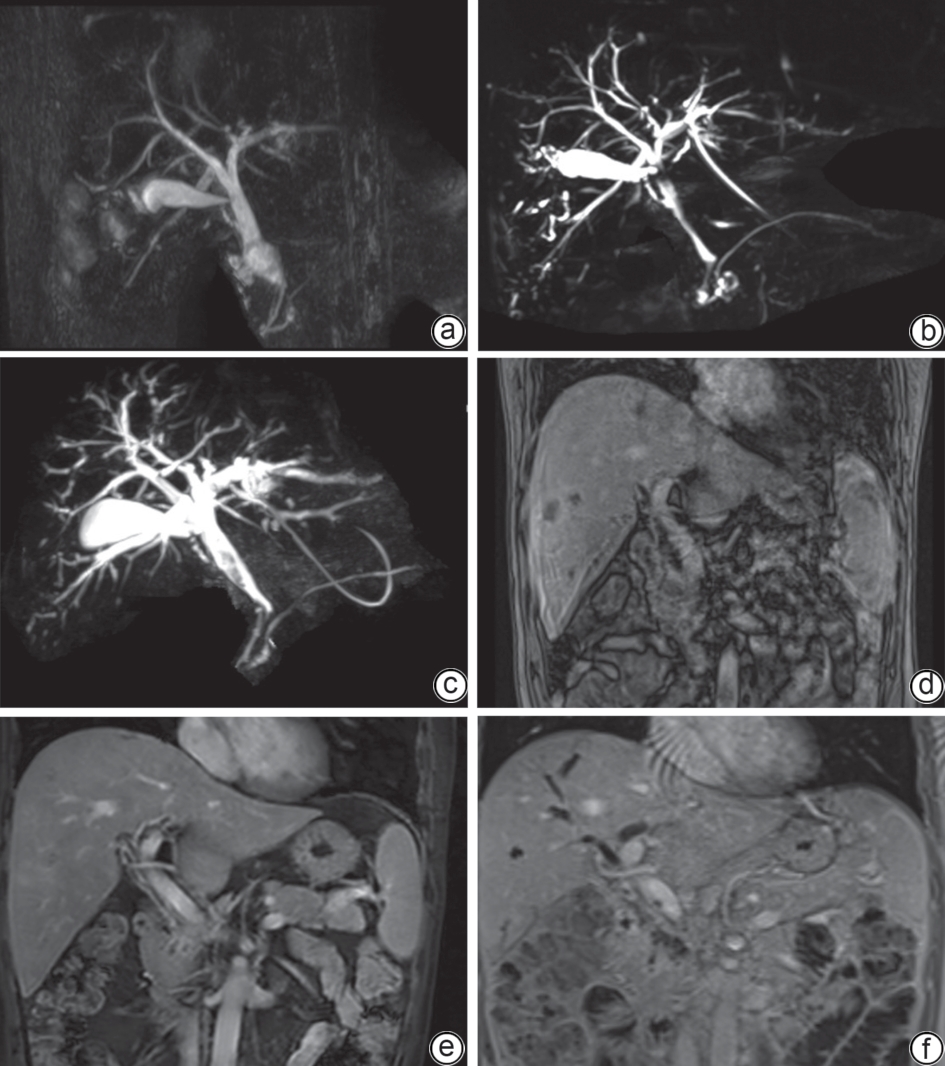
注: a~c,磁共振胰胆管成像; d~f,磁共振成像;a、d,2024年1月14日; b、e,2024年2月14日; c、f,2024年5月30日。
图 1 磁共振胰胆管成像及磁共振成像图像
Figure 1. Magnetic resonance cholangiopancreatography and magnetic resonance imaging images
-
[1] Valle J W, Kelley R K, Nervi B, et al. Biliary tract cancer[J]. Lancet, 2021, 397( 10272): 428- 444. DOI: 10.1016/S0140-6736(21)00153-7. [2] European Association for the Study of the Liver. EASL Clinical Practice Guidelines on the management of extrahepatic cholangiocarcinoma[J]. J Hepatol, 2025, 83( 1): 211- 238. DOI: 10.1016/j.jhep.2025.03.007. [3] Qurashi M, Vithayathil M, Khan S A. Epidemiology of cholangiocarcinoma[J]. Eur J Surg Oncol, 2025, 51( 2): 107064. DOI: 10.1016/j.ejso.2023.107064. [4] Razumilava N, Gores G J. Cholangiocarcinoma[J]. Lancet, 2014, 383( 9935): 2168- 2179. DOI: 10.1016/S0140-6736(13)61903-0. [5] Liu Yao, Liu Lianxin. New advances in diagnosis and treatment of advanced cholangiocarcinoma[J]. Chin J Dig Surg, 2025, 24( 7): 855- 861. DOI: 10.3760/cma.j.cn115610-20250606-00261.刘尧, 刘连新. 晚期胆管癌诊断与治疗新进展[J]. 中华消化外科杂志, 2025, 24( 7): 855- 861. DOI: 10.3760/cma.j.cn115610-20250606-00261. [6] Tjaden C, Hinz U, Klaiber U, et al. Distal bile duct cancer: Radical(R0> 1 mm) resection achieves favorable survival[J]. Ann Surg, 2023, 277( 1): e112- e118. DOI: 10.1097/SLA.0000000000005012. [7] Chen Shanshan, Li Wei. Research advances in non-surgical treatment of distal cholangiocarcinoma[J]. J Clin Hepatol, 2021, 37( 7): 1729- 1732. DOI: 10.3969/j.issn.1001-5256.2021.07.053.陈姗姗, 李威. 远端胆管癌非手术治疗的研究进展[J]. 临床肝胆病杂志, 2021, 37( 7): 1729- 1732. DOI: 10.3969/j.issn.1001-5256.2021.07.053. [8] Guedj N. Pathology of cholangiocarcinomas[J]. Curr Oncol, 2022, 30( 1): 370- 380. DOI: 10.3390/curroncol30010030. [9] Junquera Alonso E, Vargas González C, Terroba Alonso M, et al. Diagnosis of biliary papillomatosis with a Spyglass® cholangioscope[J]. Rev Esp Enferm Dig, 2022, 114( 7): 439- 440. DOI: 10.17235/reed.2022.8612/2022. [10] Rushbrook S M, Kendall T J, Zen Y, et al. British Society of Gastroenterology guidelines for the diagnosis and management of cholangiocarcinoma[J]. Gut, 2023, 73( 1): 16- 46. DOI: 10.1136/gutjnl-2023-330029. [11] Elvevi A, Laffusa A, Scaravaglio M, et al. Clinical treatment of cholangiocarcinoma: An updated comprehensive review[J]. Ann Hepatol, 2022, 27( 5): 100737. DOI: 10.1016/j.aohep.2022.100737. [12] Sugita H, Nakanuma S, Gabata R, et al. Clinicopathological features of cholangiolocarcinoma and impact of tumor heterogeneity on prognosis: A single institution retrospective study[J]. Oncol Lett, 2024, 27( 5): 213. DOI: 10.3892/ol.2024.14346. [13] Rizzo A, Brandi G. Pitfalls, challenges, and updates in adjuvant systemic treatment for resected biliary tract cancer[J]. Expert Rev Gastroenterol Hepatol, 2021, 15( 5): 547- 554. DOI: 10.1080/17474124.2021.1890031. [14] Lamarca A, Barriuso J, Chander A, et al. 18F-fluorodeoxyglucose positron emission tomography(18FDG-PET) for patients with biliary tract cancer: Systematic review and meta-analysis[J]. J Hepatol, 2019, 71( 1): 115- 129. DOI: 10.1016/j.jhep.2019.01.038. [15] van Roessel S, Soer E C, Daamen L A, et al. Preoperative misdiagnosis of pancreatic and periampullary cancer in patients undergoing pancreatoduodenectomy: A multicentre retrospective cohort study[J]. Eur J Surg Oncol, 2021, 47( 10): 2525- 2532. DOI: 10.1016/j.ejso.2021.03.228. [16] Tang Bofu, Yuanyuan Nian, Dang Tong. Advances of confocal laser endomicroscope in digestive diseases[J]. Chin J Dig Endosc, 2022, 39( 2): 164- 168. DOI: 10.3760/cma.j.cn321463-20210301-00057.汤泊夫, 年媛媛, 党彤. 激光共聚焦显微内镜在消化系统疾病中的应用进展[J]. 中华消化内镜杂志, 2022, 39( 2): 164- 168. DOI: 10.3760/cma.j.cn321463-20210301-00057. [17] Kotsifa E, Saffioti F, Mavroeidis V K. Cholangiocarcinoma: The era of liquid biopsy[J]. World J Gastroenterol, 2025, 31( 11): 104170. DOI: 10.3748/wjg.v31.i11.104170. -

 下载:
下载:
 本文二维码
本文二维码
图(2)
计量
- 文章访问数: 9
- HTML全文浏览量: 1
- PDF下载量: 1
- 被引次数: 0


