

 PDF下载 ( 2704 KB)

胰岛素样生长因子结合蛋白-3基因rs10225396位点多态性与肝细胞癌易感性的关联性分析
DOI: 10.12449/JCH260417
Association of insulin-like growth factor binding protein-3 gene polymorphism at the rs10225396 locus with susceptibility to hepatocellular carcinoma
-
摘要:
目的 探究胰岛素样生长因子结合蛋白-3(IGFBP3)基因单核苷酸多态性(SNP)位点rs10225396(A>G)与肝细胞癌易感性的关联,初步揭示其潜在的分子调控机制,为肝细胞癌的早期筛查和精准靶向治疗提供新的遗传生物标志物及理论依据。 方法 选取2009年1月—2016年8月延边大学附属医院和延边肿瘤医院收治的192例肝细胞癌患者(试验组)及同期在延边医院体检中心接受健康体检的190例健康人(对照组)为研究对象。采集研究对象的外周血,从全血中提取DNA后,将符合质量标准的DNA样本送至北京华大基因研究中心有限公司进行Mass ARRAY质谱分析,完成基因分型。计量资料两组间比较采用成组t检验,计数资料两组间比较采用χ2检验。应用二元Logistic回归模型分析IGFBP3基因rs10225396位点SNP与肝细胞癌易感性的关联并计算比值比(OR)及95%置信区间(CI),评估不同基因型携带者发生肝细胞癌的风险。 结果 IGFBP3 基因 rs10225396 位点存在 A、G 两种等位基因及 AA、AG、GG 三种基因型,其基因型分布符合Hardy-Weinberg 遗传平衡定律(χ2=0.072,P=0.789)。基因分层分析显示,在年龄<63岁、男性、有吸烟史、有饮酒史和朝鲜族人群中,IGFBP3基因rs10225396位点AA基因型携带者患肝细胞癌的风险显著增加(P值均<0.001)。二元 Logistic 回归分析显示,调整相关风险因素后,在共显性模型中,与AA基因型相比,AG、GG基因型人群患肝细胞癌的风险降低(P值均<0.001);在显性模型中,与AA基因型相比,AG+GG基因型人群患肝细胞癌的风险降低(P<0.001)。 结论 通过对吉林省延边朝鲜族自治州地区肝细胞癌患者和健康人群的基因分型分析,证实IGFBP-3基因rs10225396位点的AA基因型与肝细胞癌易感性显著相关,该基因型在特定风险因素下可显著增加肝细胞癌的发生风险,为肝细胞癌的早期筛查和精准治疗提供了潜在的遗传标志物。 -
关键词:
- 癌, 肝细胞 /
- 胰岛素样生长因子结合蛋白质3 /
- 多态性,单核苷酸
Abstract:Objective To investigate the association of the single nucleotide polymorphism (SNP) of the insulin-like growth factor binding protein-3 (IGFBP3) gene at rs10225396 (A>G) locus with the susceptibility to hepatocellular carcinoma, as well as its potential molecular regulatory mechanisms, and to provide novel genetic biomarkers and a theoretical basis for early screening and precise targeted therapy for hepatocellular carcinoma. Methods A total of 192 patients with hepatocellular carcinoma who were admitted to The Affiliated Hospital of Yanbian University and Yanbian Cancer Hospital from January 2009 to August 2016 were enrolled as experimental group, and 190 healthy individuals who underwent physical examination in Physical Examination Center of Yanbian Hospital during the same period of time were enrolled as control group. Peripheral blood samples were collected from all subjects, and after DNA was extracted from whole blood, the DNA samples meeting quality standards were sent to Beijing Genomics Institute Research Center Co., Ltd., for Mass ARRAY mass spectrometry, while genotyping was completed. The independent-samples t test was used for comparison of continuous data between two groups, and the chi-square test was used for comparison of categorical data between two groups. A binary Logistic regression model was used to analyze the association of the SNP of the IGFBP3 gene at rs10225396 locus with the susceptibility to hepatocellular carcinoma, and odds ratio (OR) and 95% confidence interval (CI) were calculated to assess the risk of developing hepatocellular carcinoma in individuals carrying different genotypes. Results There were two alleles (G and A) at the rs10225396 locus of the IGFBP3 gene, yielding the three genotypes of AA, AG, and GG, and its genotype distribution was consistent with the Hardy-Weinberg equilibrium (χ²=0.072, P=0.789). The stratified genetic analysis showed that carriers of the IGFBP3 rs10225396 AA genotype had a significant increased risk of hepatocellular carcinoma among individuals of age <63 years, male sex, smoking history, drinking history, and the Chinese Korean population (all P<0.001). The binary Logistic regression analysis showed that after adjustment for related risk factors in the codominant model, the population with genotype AG and GG had a significant reduction in the risk of hepatocellular carcinoma compared with the population with genotype AA (P<0.001), and in the dominant model, the population with genotype AG+GG had a significant reduction in the risk of hepatocellular carcinoma compared with the population with genotype AA (P<0.001). Conclusion Through a genotyping analysis of hepatocellular carcinoma patients and healthy individuals in Yanbian Korean Autonomous Prefecture of Jilin Province, China, this study shows that genotype AA at rs10225396 locus of the IGFBP3 gene is significantly associated with the susceptibility to hepatocellular carcinoma, and this genotype can significantly increase the risk of developing hepatocellular carcinoma with the presence of specific risk factors, which provides a potential genetic marker for early screening and precise treatment of hepatocellular carcinoma. -
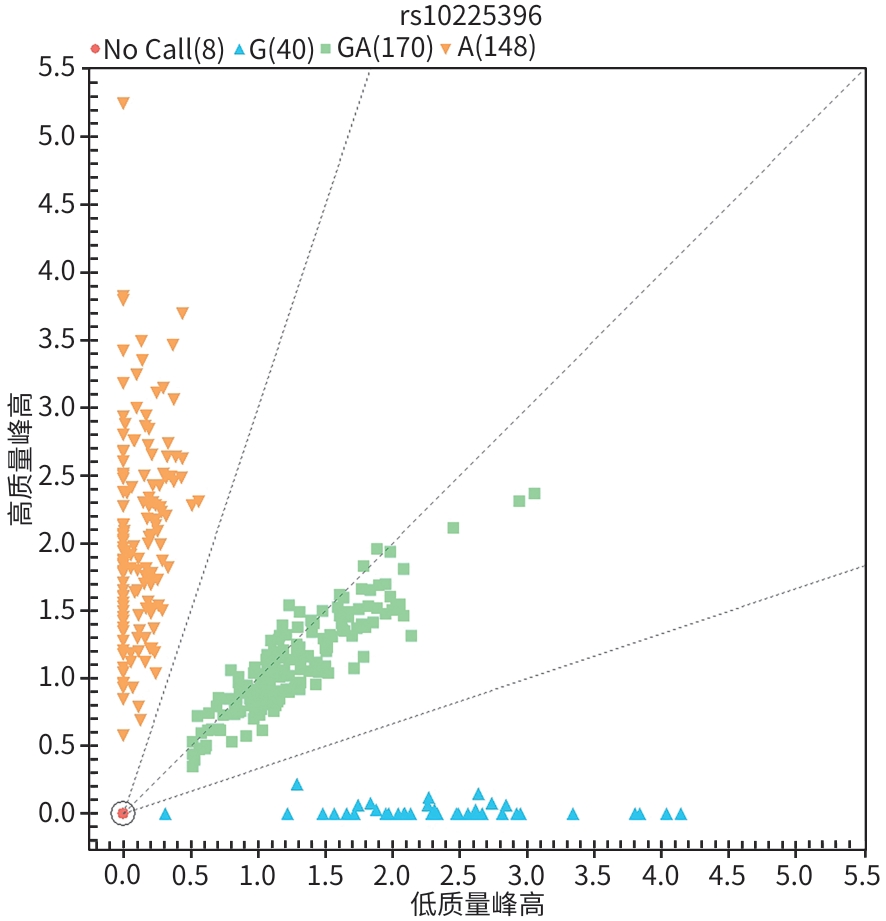
图 1 胰岛素样生长因子结合蛋白-3基因rs10225396位点测序聚类散点图
Figure 1. Scatterplot of clustering by sequencing of IGFBP3 gene at locus rs10225396
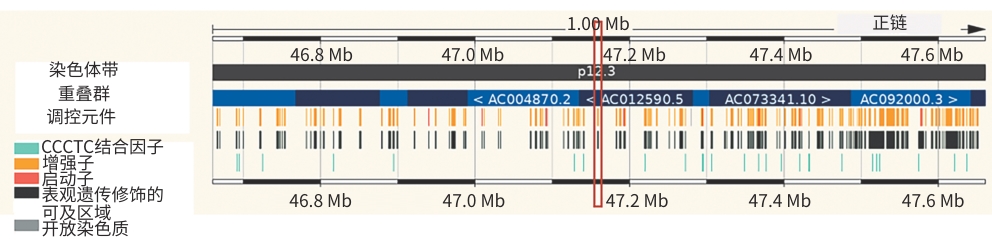
注: Mb,兆碱基对;AC,序列登录号;p,短臂;p12.3,短臂1区2带3亚带。
图 3 7号染色体rs10225396位点的调控元件分布
Figure 3. Distribution of regulatory elements at the rs10225396 locus on chromosome 7
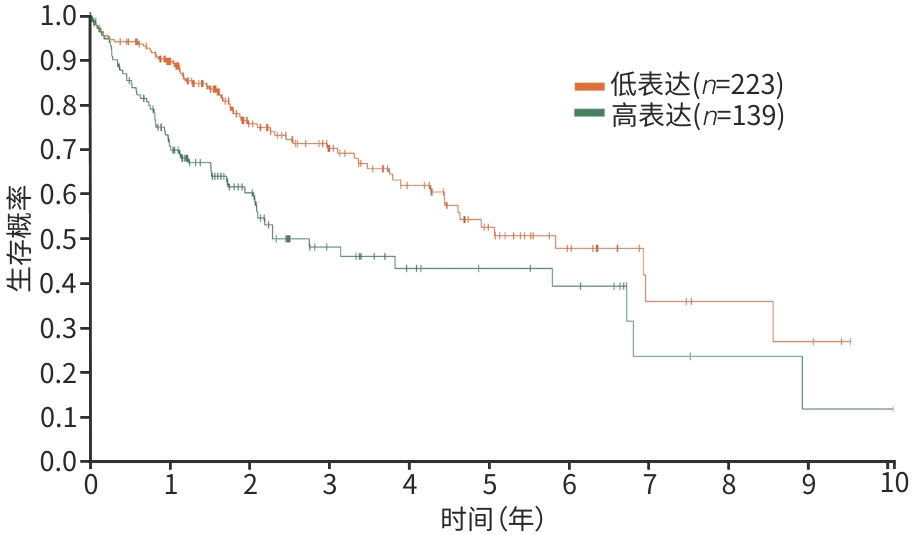
图 4 胰岛素样生长因子结合蛋白-3不同表达水平的生存率
Figure 4. Survival rates for different expression levels of IGFBP3
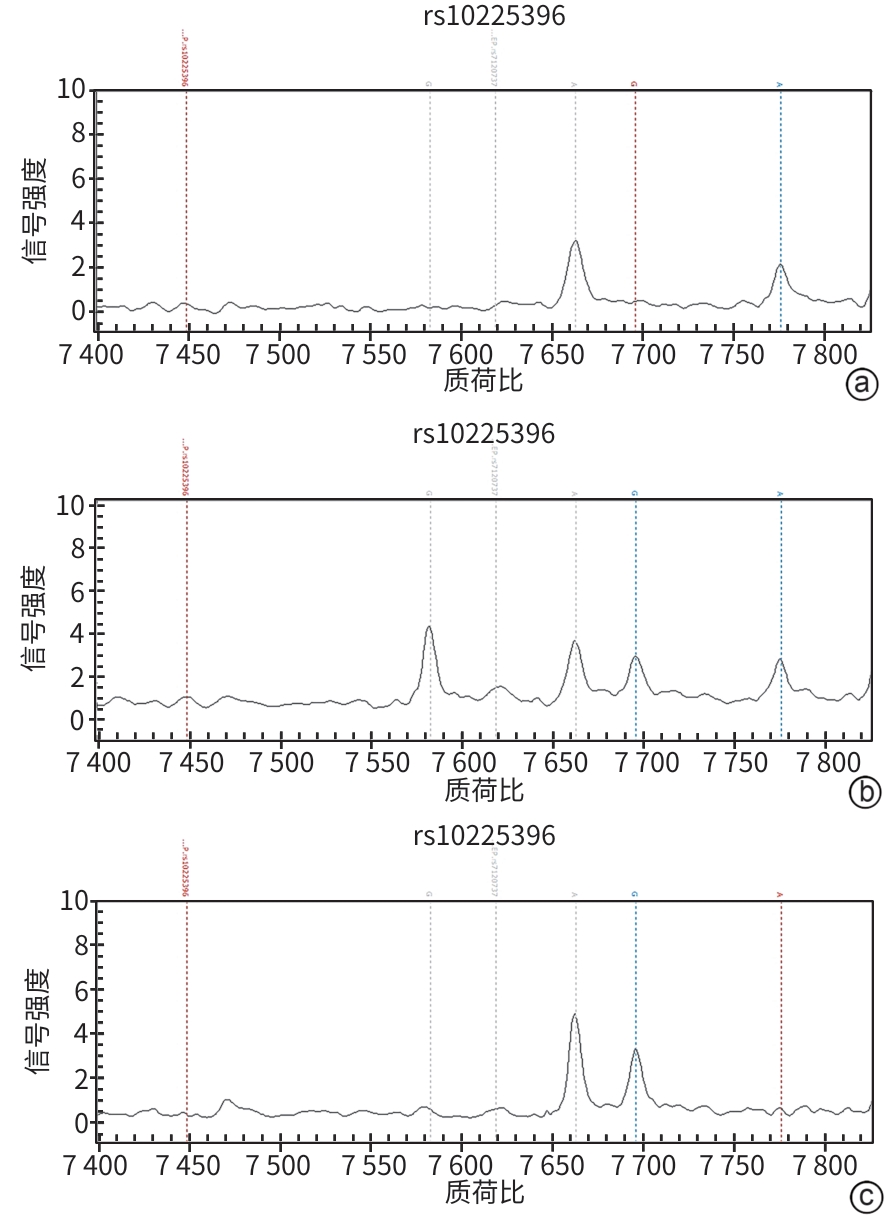
注: a,AA基因型;b,AG基因型;c,GG基因型;图中蓝色虚线标注的峰为检测得到的目标基因型。
图 5 rs10225396基因型峰值图
Figure 5. Peak plot of rs10225396 genotype
表 1 研究对象一般情况比较
Table 1. Comparison of the general conditions of the study population
因素 试验组
(n=192)对照组
(n=190)统计值 P值 年龄(岁) 61.23±10.17 62.37±10.93 t=1.055 0.292 性别[例(%)] χ2=2.322 0.128 男 142(74.0) 127(66.8) 女 50(26.0) 63(33.2) 吸烟情况[例(%)] χ2=10.717 <0.001 吸烟 113(58.9) 80(42.1) 不吸烟 79(41.1) 110(57.9) 饮酒情况[例(%)] χ2=44.624 <0.001 饮酒 121(63.0) 55(28.9) 不饮酒 71(37.0) 135(71.1) 民族[例(%)] χ2=15.918 <0.001 朝鲜族 117(60.9) 84(44.2) 汉族 75(39.1) 106(55.8)  下载: 导出CSV
表 2 IGFBP3基因rs10225396与肝细胞癌易感性关系分层分析
Table 2. Stratified analysis of the association between IGFBP3 gene rs10225396 and susceptibility to Hepatocellular Carcinoma
因素 基因型[试验组(n=192)/对照组(n=190)] AA/AG+GG模型
OR(95%CI)P值 AA AG GG 年龄(例) <63岁 46/19 40/55 8/23 3.934(2.060~7.492) <0.001 ≥63岁 49/30 39/48 10/15 2.100(1.166~3.781) 0.013 性别(例) 男 71/30 58/64 13/33 3.233(1.912~5.467) <0.001 女 24/19 21/39 5/5 2.138(0.987~4.630) 0.054 吸烟情况(例) 吸烟 56/23 46/53 11/28 3.460(1.914~6.254) <0.001 不吸烟 39/26 33/50 7/10 2.250(1.189~4.256) 0.013 饮酒情况(例) 饮酒 62/19 48/41 11/21 3.429(1.835~6.409) <0.001 不饮酒 33/30 31/62 7/17 2.287(1.221~4.285) 0.010 民族(例) 汉族 35/32 35/61 5/20 2.215(1.202~4.080) 0.011 朝鲜族 60/17 44/42 13/18 3.715(1.941~7.111) <0.001 注:IGFBP3,胰岛素样生长因子结合蛋白-3;G,鸟嘌呤;A,腺嘌呤;OR,比值比;CI,置信区间。
下载: 导出CSV
表 3 IGFBP3 rs10225396(A>G)基因型在肝细胞癌试验组与对照组中的频率分布
Table 3. Frequency distribution of IGFBP3 rs10225396 (A>G) genotypes in hepatocellular carcinoma cases and controls
基因型组合方式 试验组(n=192) 对照组(n=190) χ2 值 P值 共显性模型[例(%)] 24.992 <0.001 AA 95(49.5) 49(25.8) AG 79(41.1) 103(54.2) GG 18(9.4) 38(20.0) 隐性模型[例(%)] 8.617 0.003 AA+AG 174(90.6) 152(80.0) GG 18(9.4) 38(20.0) 显性模型[例(%)] 22.891 <0.001 AA 95(49.5) 49(25.8) AG+GG 97(50.5) 141(74.2) 注:IGFBP3,胰岛素样生长因子结合蛋白-3;SNP,单核苷酸多态性;G,鸟嘌呤;A,腺嘌呤;A>G,A→G 碱基替换。
下载: 导出CSV
表 4 基于Logistic回归分析IGFBP3 rs10225396(A>G)多态性与肝细胞癌发病风险的关联
Table 4. Logistic regression analysis of the association between IGFBP3 rs10225396 (A>G) polymorphism and hepatocellular carcinoma risk
基因型组合方式 OR(95%CI) P值 调整OR(95%CI) P值 共显性模型 AA 1.000 1.000 AG 0.396(0.252~0.622) <0.001 0.410(0.255~0.659) <0.001 GG 0.244(0.126~0.472) <0.001 0.214(0.106~0.432) <0.001 隐性模型 AA+AG 1.000 1.000 GG 0.414(0.227~0.755) 0.004 0.356(0.187~0.677) 0.002 显性模型 AA 1.000 1.000 AG+GG 0.355(0.231~0.546) <0.001 0.356(0.227~0.560) <0.001 注:IGFBP3,胰岛素样生长因子结合蛋白-3;SNP,单核苷酸多态性;G,鸟嘌呤;A,腺嘌呤;A>G,A→G碱基替换;OR,比值比;CI,置信区间。
下载: 导出CSV
-
[1] Chinese Society of Liver Cancer, Chinese Anti-Cancer Association. Chinese expert consensus on multidisciplinary treatment of liver cancer(2025)[J]. J Clin Hepatol, 2025, 41( 7): 1279- 1286. DOI: 10.12449/JCH250709.中国抗癌协会肝癌专业委员会. 中国肝癌多学科综合治疗专家共识(2025年版)[J]. 临床肝胆病杂志, 2025, 41( 7): 1279- 1286. DOI: 10.12449/JCH250709. [2] National Health Commission of the People’s Republic of China. Standard for diagnosis and treatment of primary liver cancer(2024 edition)[J]. J Clin Hepatol, 2024, 40( 5): 893- 918. DOI: 10.12449/JCH240508.中华人民共和国国家卫生健康委员会. 原发性肝癌诊疗指南(2024年版)[J]. 临床肝胆病杂志, 2024, 40( 5): 893- 918. DOI: 10.12449/JCH240508. [3] FAN J, GAO Q. New progress in liver cancer diagnosis and treatment: Guidelines lead standardization, inno-vations empower precision[J]. Chin J Dig Surg, 2024, 23( 2): 197- 203. DOI: 10.3760/cma.j.cn115610-20240112-00019.樊嘉, 高强. 肝癌诊疗新进展: 指南引领规范 创新赋能精准[J]. 中华消化外科杂志, 2024, 23( 2): 197- 203. DOI: 10.3760/cma.j.cn115610-20240112-00019. [4] LONG X, ZHANG L, WANG WQ, et al. Response of scalp and skull metastasis to anti-PD-1 antibody combined with regorafenib treatment in a sorafenib-resistant hepatocellular carcinoma patient and a literature review[J]. Onco Targets Ther, 2022, 15: 703- 716. DOI: 10.2147/OTT.S365652. [5] RUMGAY H, ARNOLD M, FERLAY J, et al. Global burden of primary liver cancer in 2020 and predictions to 2040[J]. J Hepatol, 2022, 77( 6): 1598- 1606. DOI: 10.1016/j.jhep.2022.08.021. [6] GRIMBERG A, COHEN P. Role of insulin-like growth factors and their binding proteins in growth control and carcinogenesis[J]. J Cell Physiol, 2000, 183( 1): 1- 9. DOI: 3.0.CO;2-J">10.1002/(SICI)1097-4652(200004)183: 1<1:: AID-JCP1>3.0.CO;2-J. [7] ZHANG YZ, LV X. IGFBP3 modulation of tumor pathogenesis and cell signaling pathways(Review)[J]. Oncol Lett, 2025, 30( 2): 379. DOI: 10.3892/ol.2025.15125. [8] BOYLE AP, HONG EL, HARIHARAN M, et al. Annotation of functional variation in personal genomes using RegulomeDB[J]. Genome Res, 2012, 22( 9): 1790- 1797. DOI: 10.1101/gr.137323.112. [9] MAURANO MT, HUMBERT R, RYNES E, et al. Systematic localization of common disease-associated variation in regulatory DNA[J]. Science, 2012, 337( 6099): 1190- 1195. DOI: 10.1126/science.1222794. [10] RAM M, FRASER MR, VIEIRA DOS SANTOS J, et al. The genetic and molecular drivers of multiple myeloma: Current insights, clinical implications, and the path forward[J]. Pharmgenomics Pers Med, 2024, 17: 573- 609. DOI: 10.2147/PGPM.S350238. [11] BICK AG, METCALF GA, MAYO KR, et al. Genomic data in the all of us research program[J]. Nature, 2024, 627( 8003): 340- 346. DOI: 10.1038/s41586-023-06957-x. [12] WANG JB, PANG GSY, CHONG SS, et al. SNP web resources and their potential applications in personalized medicine[J]. Curr Drug Metab, 2012, 13( 7): 978- 990. DOI: 10.2174/138920012802138552. [13] LU QC, LAO XX. Research progress of cervical cancer susceptibility gene polymorphism[J]. Chin J Fam Plan Gynecotokology, 2023, 15( 4): 14- 18. DOI: 10.3969/j.issn.1674-4020.2023.04.04.陆庆春, 劳小霞. 宫颈癌易感基因多态性的研究进展[J]. 中国计划生育和妇产科, 2023, 15( 4): 14- 18. DOI: 10.3969/j.issn.1674-4020.2023.04.04. [14] ZHU XN, WANG ZG, QIU XQ, et al. Associations between single nucleotide polymorphisms in RYBP and the prognosis of hepatocellular carcinoma in a Chinese population[J]. Carcinogenesis, 2017, 38( 5): 532- 540. DOI: 10.1093/carcin/bgx031. [15] CAO GW. Cancer in China: Epidemiological characteristics, current prophylaxis and treatment, and future strategy[J]. Acad J Nav Med Univ, 2025, 46( 3): 279- 290. DOI: 10.16781/j.CN31-2187/R.20250050. [16] PAN ZL, YIN HM, TANG HY, et al. Correlation analysis of single nucleotide polymorphisms of HLA gene with clinicopathological features and postoperative prognosis of primary hepatocellular carcinoma[J]. Med J Chin People’s Liberation Army, 2025, 50( 11): 1390- 1397. DOI: 10.11855/j.issn.0577-7402.0604.2025.0211.潘正龙, 殷浩铭, 唐豪言, 等. HLA基因单核苷酸多态性与原发性肝细胞癌临床病理特征及术后预后的相关性分析[J]. 解放军医学杂志, 2025, 50( 11): 1390- 1397. DOI: 10.11855/j.issn.0577-7402.0604.2025.0211. [17] WANG YY, ZHANG XP, LIU ZY, et al. Association analysis of SLC16A11 SLC16A13 gene polymorphism and hepatitis B-related liver cancer[J]. J Hebei Med Univ, 2023, 44( 1): 16- 19, 67. DOI: 10.3969/j.issn.1007-3205.2023.01.004.王莹莹, 张贤培, 刘震阳, 等. SLC16A11、SLC16A13基因多态性与乙型肝炎相关性肝癌的关联性分析[J]. 河北医科大学学报, 2023, 44( 1): 16- 19, 67. DOI: 10.3969/j.issn.1007-3205.2023.01.004. [18] WANG YR, WANG C, LIU XZ, et al. Mechanism of emodin induces apoptosis of gastric cancer cells by intervening insulin-like growth factor-1 receptor[J]. Pharmacol Clin Chin Mater Med, 2024, 40( 12): 60- 66. DOI: 10.13412/j.cnki.zyyl.20240612.002.王燕如, 王超, 刘秀珠, 等. 大黄素干预胰岛素生长因子受体诱导胃癌细胞凋亡的作用机制[J]. 中药药理与临床, 2024, 40( 12): 60- 66. DOI: 10.13412/j.cnki.zyyl.20240612.002. [19] TIAN J, FU Y, SUN Y, et al. The roles of Insulin-like growth factor signaling axis and its inhibitors in tumors[J]. J Northwest Univ Nat Sci Ed, 2024, 54( 5): 876- 888. DOI: 10.16152/j.cnki.xdxbzr.2024-05-010.田静, 付瑶, 孙钰, 等. 胰岛素样生长因子信号轴与其抑制剂在肿瘤中的作用[J]. 西北大学学报(自然科学版), 2024, 54( 5): 876- 888. DOI: 10.16152/j.cnki.xdxbzr.2024-05-010. [20] ZHANG NC, ZHANG L, PENG Y, et al. Yak IGFBP3 promotes hepatocyte proliferation through PI3K-Akt signaling pathway[J]. Gene, 2024, 917: 148460. DOI: 10.1016/j.gene.2024.148460. [21] XIA L, RUAN M, HUANG Q, et al. Abnormal expression of IGFBP3 gene and prognosis of hepatocellular carcinoma[J]. China Health Stand Manag, 2024, 15( 16): 135- 141. DOI: 10.3969/j.issn.1674-9316.2024.16.032.夏磊, 阮梅, 黄倩, 等. IGFBP3基因的异常表达与肝细胞癌的预后关系[J]. 中国卫生标准管理, 2024, 15( 16): 135- 141. DOI: 10.3969/j.issn.1674-9316.2024.16.032. [22] ZHANG PR, LI HG, ZHUO JY, et al. Remodeling of the internal environment in hepatocellular carcinoma: A synergistic mechanism of exogenous exposure[J]. Biomed Transform, 2025, 6( 2): 8- 13. DOI: 10.12287/j.issn.2096-8965.20250202.张培儒, 李辉港, 卓建勇, 等. 肝癌内环境重塑: 外源性暴露的协同作用机制[J]. 生物医学转化, 2025, 6( 2): 8- 13. DOI: 10.12287/j.issn.2096-8965.20250202. [23] CHO EJ, CHUNG GE, YOO JJ, et al. The association between alcohol consumption and the risk of hepatocellular carcinoma according to glycemic status in Korea: A nationwide population-based study[J]. PLoS Med, 2023, 20( 6): e1004244. DOI: 10.1371/journal.pmed.1004244. [24] SHU WX, LIU L, JIANG JJ, et al. Dietary patterns and hepatocellular carcinoma risk: A systematic review and meta-analysis of cohort and case-control studies[J]. Nutr Metab, 2024, 21( 1): 47. DOI: 10.1186/s12986-024-00822-y. -


 本文二维码
本文二维码
计量
- 文章访问数: 294
- HTML全文浏览量: 166
- PDF下载量: 86
- 被引次数: 0


